


Sierra Leone

Sierra Leone 2026
Geospatial Typologies
Agro-informatics connects information technology with the management, analysis and application of agricultural data to indentify territories with untapped agrifood potential and design more accurate and targeted agrifood interventions. The use of new technologies and techniques in agriculture, such as satellite imagery, remote sensing, and geographic information systems, enable the transformation of data into actionable information.
POVERTY
POTENTIAL
EFFICIENCY

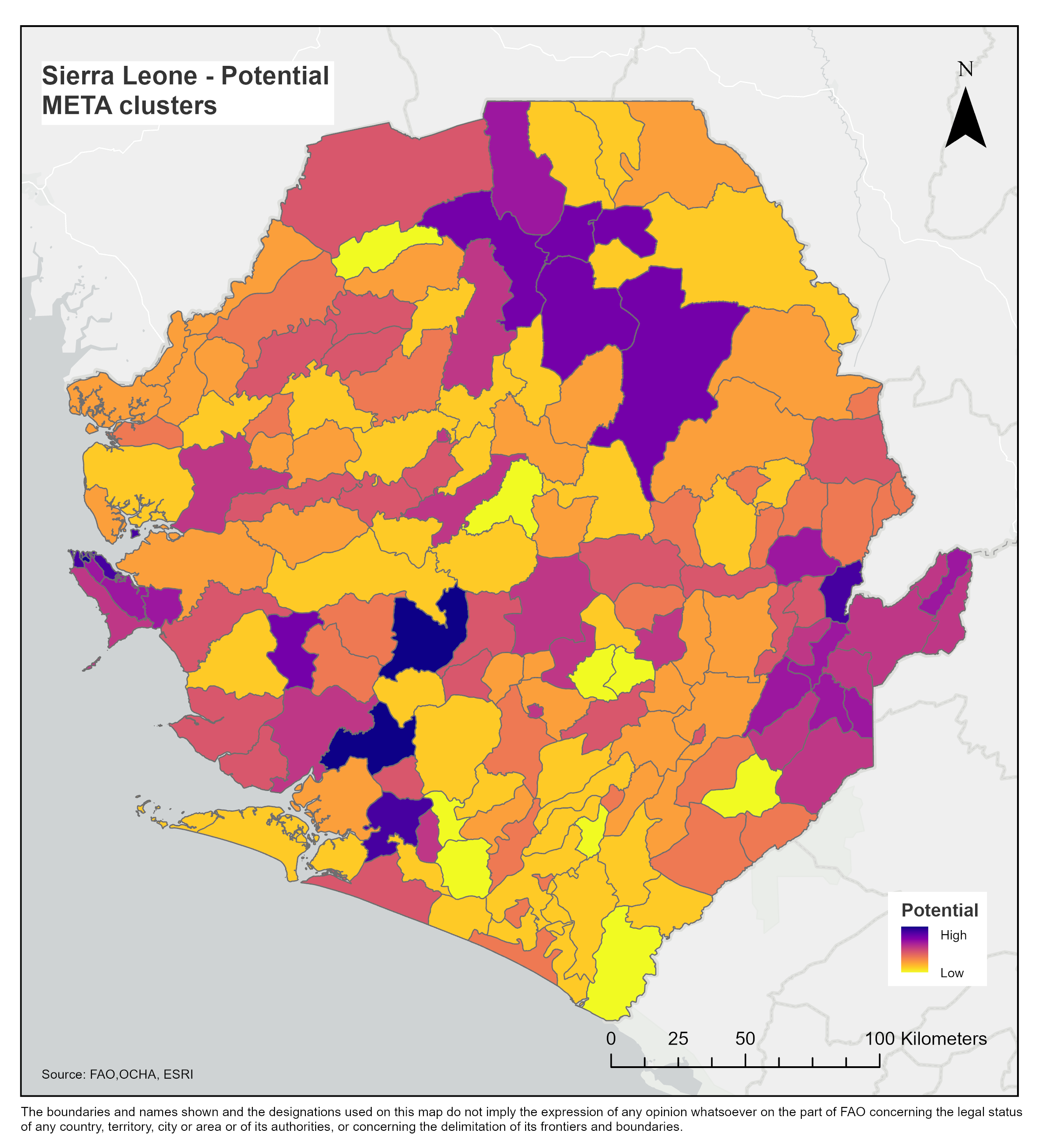

Click on individual maps to get a detailed view on FAO GIS platform
Invest in Sierra Leone
Investment cases and interventions

Rice
INVESTMENT
USD 191M
INTERNAL RATE OF RETURN (%)
32.1%
NET PRESENT VALUE
USD 20.6M
DIRECT BENEFICIARIES
38,200
INDIRECT BENEFICIARIES
229,000
INCOME INCREASE PER CAPITA
215 USD/person
EMISSION REDUTION (EXACT)
+473,265 tCO₂e (20yrs)
Imports meet one third of national rice demand, 350,000 to 450,000 tonnes a year, valued at USD 150–200 million. Substituting even part of that volume with domestic production is the largest single import-substitution opportunity in Sierra Leone's agrifood system, and it eases pressure on foreign exchange at the same time. The productivity gap makes the case commercially. Yields average 2.0 to 2.4 tonnes per hectare against a demonstrated potential of 8 tonnes. Milling capacity is only around 40 percent utilized, so even existing assets are producing well below what they could. The investment addresses both ends of the chain: the equipment that raises what farmers harvest, and the mills and storage that determine how much of it reaches the market in saleable condition.
Key bottlenecks
- Limited affordability of equipment, seasonal use patterns, and maintenance constraints
- Rural infrastructure constraints, competition from imports, and post-harvest losses • Weak coordination, limited access to finance, and weak aggregation
What the investment delivers
- Mechanization service centres: 250 mechanization packages and 250 workshops and service sheds, operating on a rental and shared-service model. USD 100.0 million, private.
- Post-harvest and processing: rehabilitation of 204 mills, construction of 160 new mills, equipping of 364 mills, and 72,000 m² of storage. USD 49.2 million, private and PPP.
- Aggregation, storage and financing: 66 cluster-level aggregation hubs and 5 financing facilities. USD 41.8 million, PPP.
The target By 2028: halve rice imports, double yields to 4 tonnes per hectare, raise milling utilisation to 80 percent, and bring post-harvest losses below 10 percent.

Cassava
INVESTMENT
USD 41.5M
INTERNAL RATE OF RETURN (%)
23.1%
NET PRESENT VALUE
USD 22.1M
DIRECT BENEFICIARIES
9,730
INDIRECT BENEFICIARIES
58,400
INCOME INCREASE PER CAPITA
200 USD/person
EMISSION REDUTION (EXACT)
-111,837 tCO2-e (20yrs)
The opportunity Cassava is Sierra Leone's second staple after rice and contributes 57.4 percent of agricultural GDP, with 2.6 million tonnes produced on 155,706 hectares on a largely smallholder basis. Yields sit at around 15 tonnes per hectare against a potential of 60 — the widest productivity gap of any crop in the portfolio, and the reason a comparatively small investment carries the strongest return ratio of the four cases. The export story is already happening; it is simply happening informally. Formal garri exports grew from 1.6 to 42 tonnes between 2021 and 2025, while informal cross-border trade to Guinea and Liberia runs at an estimated 600 tonnes a week. The gap between those two figures is the opportunity. Capturing that trade in formal, traceable channels raises smallholder prices, generates recorded export earnings, and opens the way to higher-value products — high quality cassava flour and industrial starch for regional and international markets. Traceability is why this is the one Sierra Leonean case carrying the Digital impact tag.
Key bottlenecks
- Yield gains below expectations, cassava mosaic disease, and climate variability
- Unreliable fresh cassava supply, low ramp-up throughput, and thin processing margins • Road disruption in the rainy season and coordination across many smallholders • Limited access to finance and weak managerial capacity
What the investment delivers
- Cassava production clusters: 15 clusters across 25,000 hectares with 250 Farmer Field Schools. USD 24.0 million, private.
- HQCF and starch processing: 3 processing units and 3 small-capacity units. USD 6.2 million, private.
- Collection and logistics network: 15 collection and aggregation networks and 55 transport-support packages. USD 5.7 million, PPP.
- Financing and capacity building: 5 financing cycles and windows. USD 5.6 million, PPP.
The target Formalise the export channel and launch trade in high quality cassava flour and starch for regional and international markets.

Poultry Feed
INVESTMENT
USD 241.5M
INTERNAL RATE OF RETURN (%)
22.9%
NET PRESENT VALUE
USD 35.7M
DIRECT BENEFICIARIES
60,599
INDIRECT BENEFICIARIES
363,592
INCOME INCREASE PER CAPITA
197 USD/person
EMISSION REDUTION (EXACT)
+4,105,260 tCO₂e (20yrs)
Sierra Leone spends approximately USD 40 million a year on chicken and egg imports, with 60 percent of chicken meat and 40 percent of eggs coming from abroad. Demand is moving in the right direction for a domestic producer: poultry consumption rose 47 percent between 2018 and 2022. The market exists; the supply does not. Feed is what determines whether domestic supply can meet it. Feed accounts for 60 to 75 percent of poultry production cost, and local milling capacity is limited, which leaves producers exposed to imported feed prices they cannot control. That is why feed and poultry are presented as a single integrated case rather than two separate ones, and why feed crop production absorbs 72 percent of the capital in this case. Bringing feed onshore is the precondition for everything downstream of it.
Key bottlenecks
- Volatile maize and soya prices, competition from imported feed, and climate variability
- Inconsistent feedstock supply, low mill utilisation, and feed quality risks • Disease outbreaks, competition from frozen imports, and high input costs
- Weak market linkages and limited access to affordable finance
What the investment delivers
- Feed crop production: 110,000 hectares of commercial maize and soya, 27 market-linkage hubs, and 550 Farmer Field Schools. USD 173.2 million, PPP.
- Feed mills: 3 regional mills at 7 tonnes per hour and 55 small mills at 1 tonne per day. USD 22.9 million, PPP. • Broiler and hatchery expansion: 110 commercial broiler and layer farms, 5 hatchery investments, and cold-chain systems. USD 35.4 million, private.
- Market linkages and financing: contract farming and B2B development plus access-to-finance facilities. USD 10.0 million, PPP.
The target By 2028: halve poultry production costs through locally produced feed, and cut frozen chicken and egg import volumes by half.

Palm oil
INVESTMENT
USD 285.7M
INTERNAL RATE OF RETURN (%)
28.6%
NET PRESENT VALUE
USD 43.8M
DIRECT BENEFICIARIES
29,421
INDIRECT BENEFICIARIES
176,500
INCOME INCREASE PER CAPITA
270 USD/person
EMISSION REDUTION (EXACT)
-3,589,5521 tCO₂e (20yrs)
The opportunity Palm oil is Sierra Leone's second-largest agricultural export, with annual crude palm oil production of around 50,000 tonnes valued at roughly USD 50 million. Unlike the other cases in the portfolio, this one starts from an established commercial base. Global demand supports expansion: palm oil accounts for about 35 percent of world vegetable oil demand, and West Africa is gaining share. Around 70 percent of smallholder output currently leaves the country informally for Guinea, which means a substantial share of the value created never registers as national export earnings and never reaches domestic processors. The 2022 Customary Land Law is easing land access, removing what has historically been the binding constraint on plantation-scale investment. This is also the strongest environmental case in the portfolio: rehabilitation and expansion deliver a net carbon benefit of 3.6 million tonnes of CO₂ equivalent over twenty years.
Key bottlenecks
- Slow yield recovery, climate variability, and disease pressure
- Low mill utilisation and feedstock shortages
- High operating costs and technical constraints in processing
- Limited uptake of available finance
What the investment delivers
- Production rehabilitation and expansion: rehabilitate or expand 40,000 hectares, 400 Farmer Field Schools, and 800 km of feeder roads. USD 123.2 million, private.
- Community and cluster mills: 40 community and cluster palm oil mills. USD 80.0 million, PPP.
- Integrated processing and refining: 8 medium integrated mills and 4 refinery and downstream facilities. USD 80.0 million, private and PPP.
- Access to finance and value chain support: 5 financing windows and facilities. USD 2.5 million, PPP.
The target By 2032: scale production to supply domestic processing and export markets, and eliminate imports.
Resources
FAO's Hand-in-Hand Initiative
21/12/2023
The Hand-in-Hand (HIH) Initiative supports the implementation of nationally led, ambitious programmes to accelerate agrifood systems transformations...
Contacts
For more information, please contact the Hand-in-Hand team