


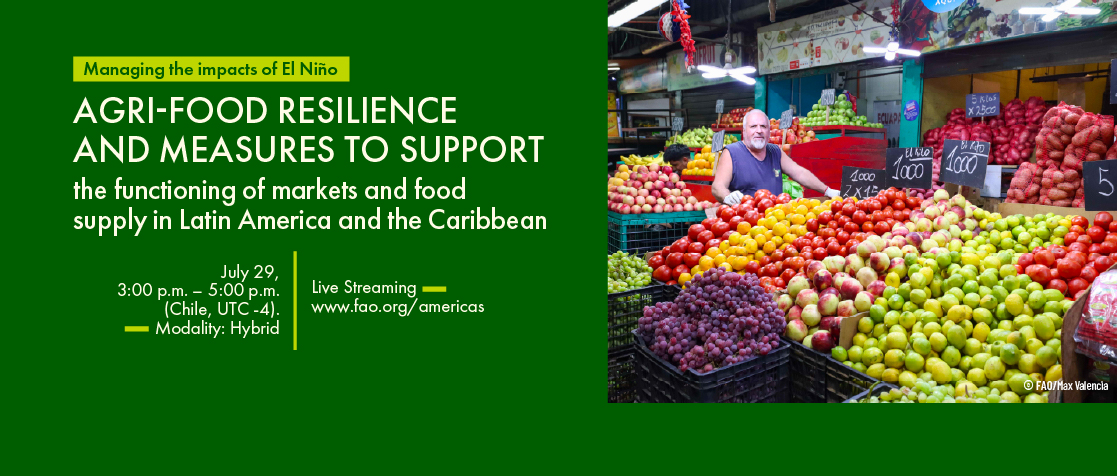
Managing the impacts of El Niño
Agri-food resilience and measures to support the functioning of markets and food supply in LAC
Hybrid Event, 29/07/2026
Broadcast
Context
The El Niño phenomenon represents one of the climatic events with the greatest impact in the region, characterized by an anomalous warming of the surface waters of the equatorial Pacific Ocean. This phenomenon has profound and multifaceted consequences on weather patterns, generating significant alterations in ecological, agricultural, and social systems (NOAA, 2023).
In the region, El Niño is often associated with extreme droughts in some areas, which affect the availability of water for agriculture and human consumption, and with heavy rains and floods in others, which destroy crops, infrastructure, and generate substantial economic losses (ECLAC, 2022). These climatic alterations cause a reduction in agricultural productivity, decrease the availability of food, and raise prices, especially affecting the most vulnerable populations (FAO, 2022).
The most recent seasonal forecasts from the World Production Centres of the World Meteorological Organization (WMO) show a marked shift in the situation towards typical El Niño conditions. Thus, the probability of the formation of an El Niño episode between June and August 2026 is 80%.
The impact on food security is particularly alarming, as declines in agricultural production limit access to nutritious food, increase food insecurity, and exacerbate poverty (WHO, 2023). Rural communities, dependent on subsistence agriculture, face greater risks of malnutrition and food vulnerability in the face of the recurrence of this phenomenon (World Bank, 2023).
In this context, traditional markets and public supply systems play a crucial role as mitigation and response mechanisms. They are strategic spaces where access to food at reasonable prices can be promoted and supply chains can be strengthened in times of crisis.
The resilience of these markets, together with integrated policies and community actions, is essential to reduce the impacts of the El Niño phenomenon and ensure food security for the most affected population.
A deep understanding of this phenomenon and its effects allows for the design of effective strategies for adaptation and mitigation, strengthening the capacity of urban and rural communities and food systems to withstand the onslaught of extreme weather events and protect the fundamental right to adequate food (FAO, 2022).
To reflect on the impact of this phenomenon at the global and regional levels, we will hold this discussion initially seeking to understand more deeply the global scope of El Niño, impacts on agriculture, value chains, international trade and on food security and livelihoods, dialoguing with strategies focused on agri-food resilience in the territories.
Next, we will address the opportunities offered by traditional markets and public supply systems in Latin America and the Caribbean, focused on expanding the knowledge and capacity of the participating countries to minimize the impacts of the El Niño phenomenon on food security in the region, promoting, through markets and supply systems, strategies for adaptation, mitigation and strengthening of the resilience of agrifood systems, as a key mechanism to reduce vulnerability and guarantee the right to adequate food.
In the Latin American and Caribbean region, 39% of public food supply and commercialization institutions (SPAAs) have implemented food commercialization initiatives, such as warehouses, stores or supermarkets, aimed at meeting the population's need for access to basic products in the food basket, particularly for populations in rural and peri-urban areas (FAO and IBD, 2024)
And complementing this approach, considering the high level of urbanization in LAC, it is also essential to talk about how communities, especially those living in the peripheral areas of cities, can organize in alliance with the public authorities, to design and implement community plans for risk prevention and adaptation to climate change, which plan preventive actions directly in the neighborhoods, strengthening agri-food resilience in these territories.
General objective
Strengthen the understanding and capacities of regional actors in managing the impact of the El Niño phenomenon on food security and livelihoods, promoting adaptation, mitigation, and resilience strategies in agrifood systems and urban and rural communities in Latin America and the Caribbean.
Specific objectives
Analyze the effects of the El Niño phenomenon on global and regional weather patterns, agriculture, and food security in the region, identifying challenges and opportunities for risk management and mitigation.
Emphasize the importance of traditional markets and food supply systems in LAC, as promoters of programs and policies that expand and strengthen access to healthy food at affordable prices in the region, especially for vulnerable populations
Promote the exchange of good practices and innovative strategies in traditional markets, supply systems, and community organizations, to strengthen the resilience of food systems to extreme weather events.
Expected results
Provide technical inputs to improve the design and implementation of policies and actions that strengthen resilience and adaptation to El Niño, guaranteeing the right to adequate food at the urban level and especially for the most vulnerable families.
Recognize the importance of traditional food markets for the proper functioning of agrifood systems, as well as their role in establishing an inclusive and efficient food supply system. This is essential to reduce the vulnerability of food security to extreme weather events associated with the El Niño phenomenon.
Documents
Agenda
.jpg?Status=Master&sfvrsn=7efe18ae_1)