Webinar series on Priorities in Food Safety: Food Safety in Bivalve Molluscs
Virtual Event, 25/06/2026
.jpg?sfvrsn=48e4f51_4 "Webinar series on Priorities in Food Safety: Food Safety in Bivalve Molluscs")
Broadcast
Background
Within the framework of the 2026-2027 Regional Food Safety Programmatic Agenda, the Food and Agriculture Organization of the United Nations (FAO), through its Regional Office for Latin America and the Caribbean, invites countries in the region to participate in the upcoming webinar, to be held on June 25, 2026, focusing on “Food Safety in Bivalve Molluscs.”
This event provides a technical forum aimed at strengthening capacities and exchanging experiences on priority food safety issues in the region.
In this context, bivalve molluscs represent a resource of particular importance due to their economic, nutritional, and social significance for numerous countries in the region. However, because they are filter-feeding organisms, they can accumulate pathogenic microorganisms, chemical contaminants, and marine biotoxins, making it essential to have surveillance, monitoring, and sanitary control systems in place to manage the risks associated with their production and consumption in a timely manner.
Therefore, the next module will be dedicated to the monitoring of marine biotoxins and bivalve mollusc health programs, addressing technical tools, risk management approaches, and national experiences related to strengthening control systems.
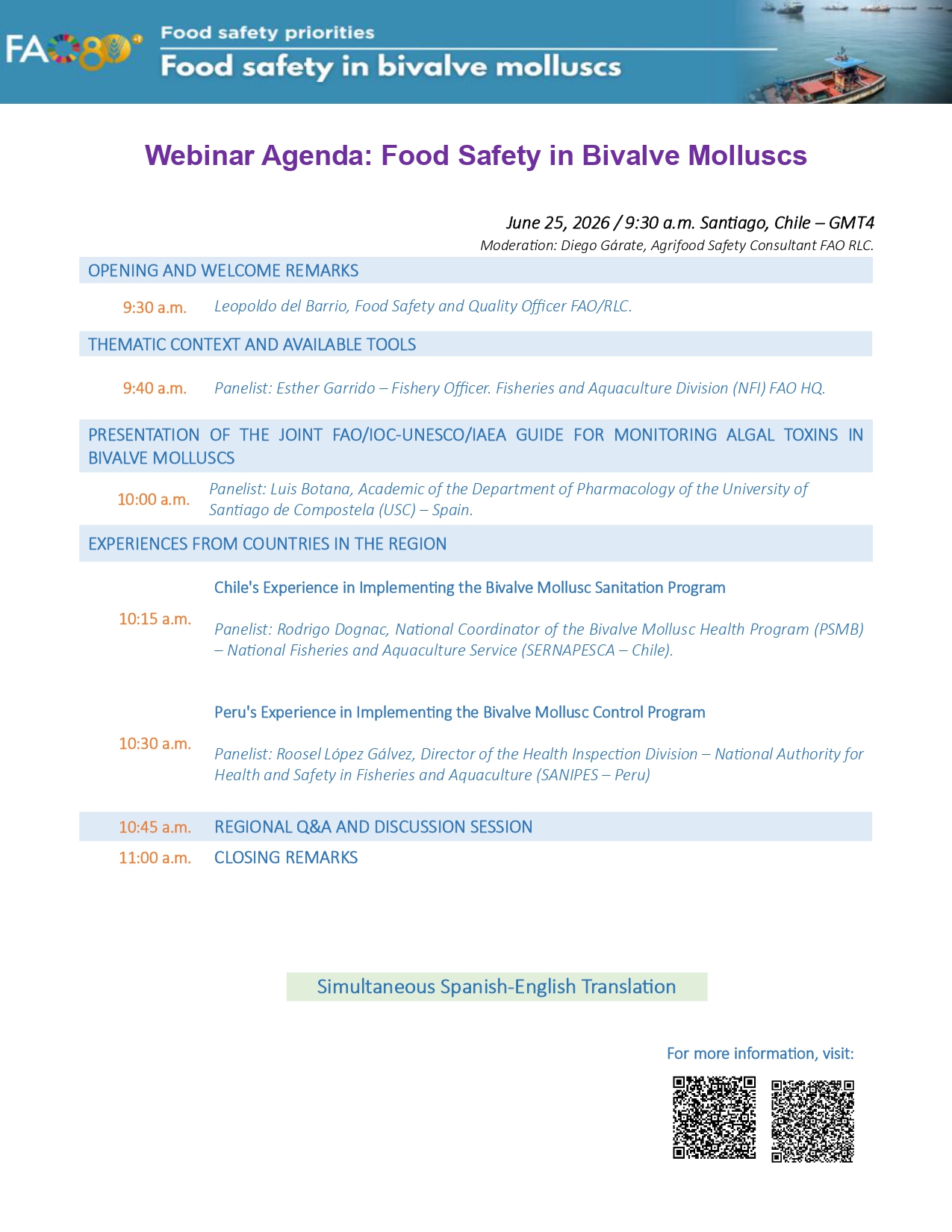
During the activity, the Joint FAO/IOC-UNESCO/IAEA Guide for Monitoring Algal Toxins in Bivalve Molluscs will be presented. This technical tool provides guidance for establishing and strengthening monitoring and risk management programs associated with marine biotoxins, contributing to the protection of public health and the strengthening of official control systems.
Representatives from the Chilean National Fisheries Service (SERNAPESCA) and the Peruvian National Authority for Health and Safety in Fisheries and Aquaculture (SANIPES) will also share their national experiences, addressing the maturation of their programs, official surveillance mechanisms, institutional and inter-institutional coordination, and the approaches used for health risk management.
Health authorities, professionals from the fisheries, aquaculture and food safety sectors, laboratory representatives, academics and other stakeholders interested in learning about tools, experiences and challenges related to the safety, monitoring and health management of bivalve molluscs are invited.