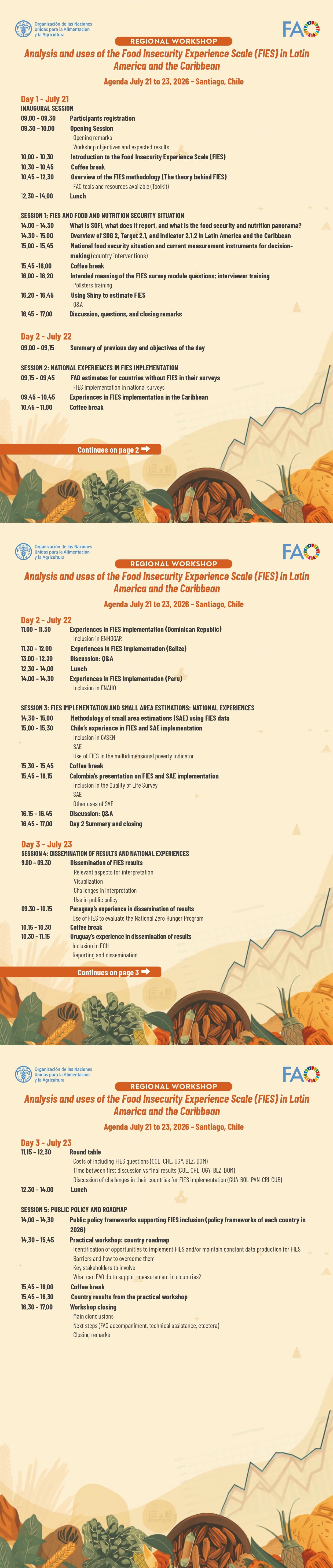
Regional Workshop on Analysis and Uses of the Food Insecurity Experience Scale (FIES) in Latin America and the Caribbean
Hybrid Event, 21/07/2026 - 23/07/2026
Moderate or severe food insecurity affected 1 in 4 people in Latin America and the Caribbean in 2024. And, although this figure has been steadily decreasing since 2020, its prevalence means that 167 million people face moderate or severe difficulties accessing food.
The Food and Agriculture Organization of the United Nations (FAO) is working to help countries achieve the goal of ending hunger and ensuring access for all people, particularly those in vulnerable situations, including children under 1 year of age, to safe, nutritious, and sufficient food year-round by 2030.
To that end, the FAO Regional Office for Latin America and the Caribbean has convened the Regional Workshop on the Analysis and Uses of the Food Insecurity Experience Scale (FIES) in Latin America and the Caribbean. Indicator 2.1.2 of the Sustainable Development Goals (SDGs) is fundamental because it provides a direct and multidimensional measurement of food insecurity through the Food Insecurity Experience Scale (FIES), which captures people's actual ability to access food and the restrictions they experience due to a lack of money or other resources.
Its importance lies in its ability to identify not only severe hunger but also moderate food insecurity, where people have had to reduce the quality or quantity of their diet. By focusing on the human experience, indicator 2.1.2 provides timely and disaggregated data that are crucial for governments to design more precise public policies, monitor progress toward the Zero Hunger goal, and ensure that no vulnerable population is left behind on the path to 2030.
Workshop Objectives
- To strengthen the capacity of staff responsible for monitoring indicator 2.1.2 in each country in the use of the FIES analytical protocol, particularly in calculating the prevalence of food insecurity within the framework of the Rasch model;
- To highlight the strategic relevance of the annual report “The State of Food Security and Nutrition in the World” (SOFI) as the main global instrument for monitoring progress in eradicating hunger;
- To underscore the importance of adopting a common scale such as FIES to ensure the international comparability of data;
- To provide a forum for countries that have already integrated FIES into their national surveys to share lessons learned, challenges, and opportunities for improvement;
- To analyze advanced methodologies such as Small Area Estimation (SAE), aimed at obtaining disaggregated information at the lowest possible administrative level for more precise and effective decision-making.
Participants
Officials involved in the estimation of the FIES and using the data in public policy belonging to national statistical offices and/or ministries.
Background
The Food and Agriculture Organization of the United Nations (FAO) developed the Food Insecurity Scale (FIES) as a standard methodology for assessing food access at the household or individual level. Through eight questions about specific experiences of food insecurity, this tool can be administered independently or integrated into national household surveys.
However, significant challenges persist in Latin America and the Caribbean: while some countries have not yet begun monitoring the indicator, others lack consensus on which scale to use, due to the coexistence of regional alternatives such as the Latin American and Caribbean Food Security Scale (ELCSA), the Brazilian Food Insecurity Scale (EBIA), and the Mexican Food Security Scale (EMSA).