


.jpg?sfvrsn=131e3ba6_5 "Shrimp farming on dry land: a strategy transforming livelihoods in Brazil")
Shrimp farming on dry land: a strategy transforming livelihoods in Brazil
Shrimp raised in brackish water can nourish far more than people: it can nurture dreams for the future in some of the driest corners of the continent.


In northeastern Brazil, recent aquaculture activity is already having a positive impact on hundreds of families in rural communities.
FAO/Julio Vasconcelos
25/02/2026
Traditionally, the image of Brazil’s semi-arid region has been associated with water scarcity, drought and the difficulty of producing food consistently. Yet a quiet transformation is changing that reality: rural communities in the interior of Brazil’s Northeast are adopting shrimp aquaculture as an alternative source of income, making use of local resources and joining forces through associative work.
Brazil’s Ministry of Fisheries and Aquaculture (MPA), in cooperation with the Food and Agriculture Organization of the United Nations (FAO), developed a project to support small-scale aquaculture producers in this region by providing access to digital tools that help monitor and improve production.
In coordination with the technical assistance provided by the Brazilian Micro and Small Business Support Service (Sebrae), the initiative is being implemented in six municipalities in the interior of the state of Alagoas, one of the poorest in the country. It aims to strengthen local productive organization through technical training and capacity development in associativity and cooperativism.
Brazil is currently the world’s fourth-largest producer of tilapia, a sector largely developed by cooperatives in the south of the country. The project’s goal is to replicate this aquaculture model across the Northeast, generating income for vulnerable farmers. In Alagoas, this process has been driven by the use of local brackish water, which has become a source of income through marine shrimp production. Between 2018 and 2023, shrimp farming in the state increased from 435 tonnes to 1,6 millions tonnes.
Although aquaculture is a relatively recent activity, it is already positively impacting hundreds of families.
Among those engaged in shrimp farming are Rejane Madalena de Alcântara, a rural producer who supports her family through shrimp sales; Marinho Eduardo Martins, a farmer who found in aquaculture a new opportunity in life; and Iury Amorim, a fisheries engineer, president of a local cooperative and project extension officer.
Their stories show how the combination of technical knowledge, institutional support and collective work can change realities.
The nine siblings of Coité do Nóia
Rejane Madalena de Alcântara, from Coité do Nóia in the interior of Alagoas, saw her life change thanks to her family’s unity around a shared project. Together with her eight siblings, she transformed their late father’s property into a family hub for shrimp farming. The first step came from one of her brothers, a public school teacher who heard from a student about the success of shrimp farming in the region.
He believed in the activity’s potential and invested part of his salary to build the first cultivation ponds in 2018. With positive results from the initial cycles, he encouraged his siblings to follow the same path, financing the construction of new ponds on the family land. Today, the family operates 29 ponds: each of the nine siblings manages their own production modules, and nieces and nephews also take part, forming an intergenerational network of work. All of them are members of the Alagoas Shrimp Farmers Association.
“The best part is that we have already repaid our brother and are now making profits,” says Rejane, who uses income from the harvests to cover household expenses and ensure continuous treatment for her son, who requires regular therapies. “That money makes all the difference for our family. We started small, with great effort, but with technical support and dedication we improved our management and increased productivity,” she explains.
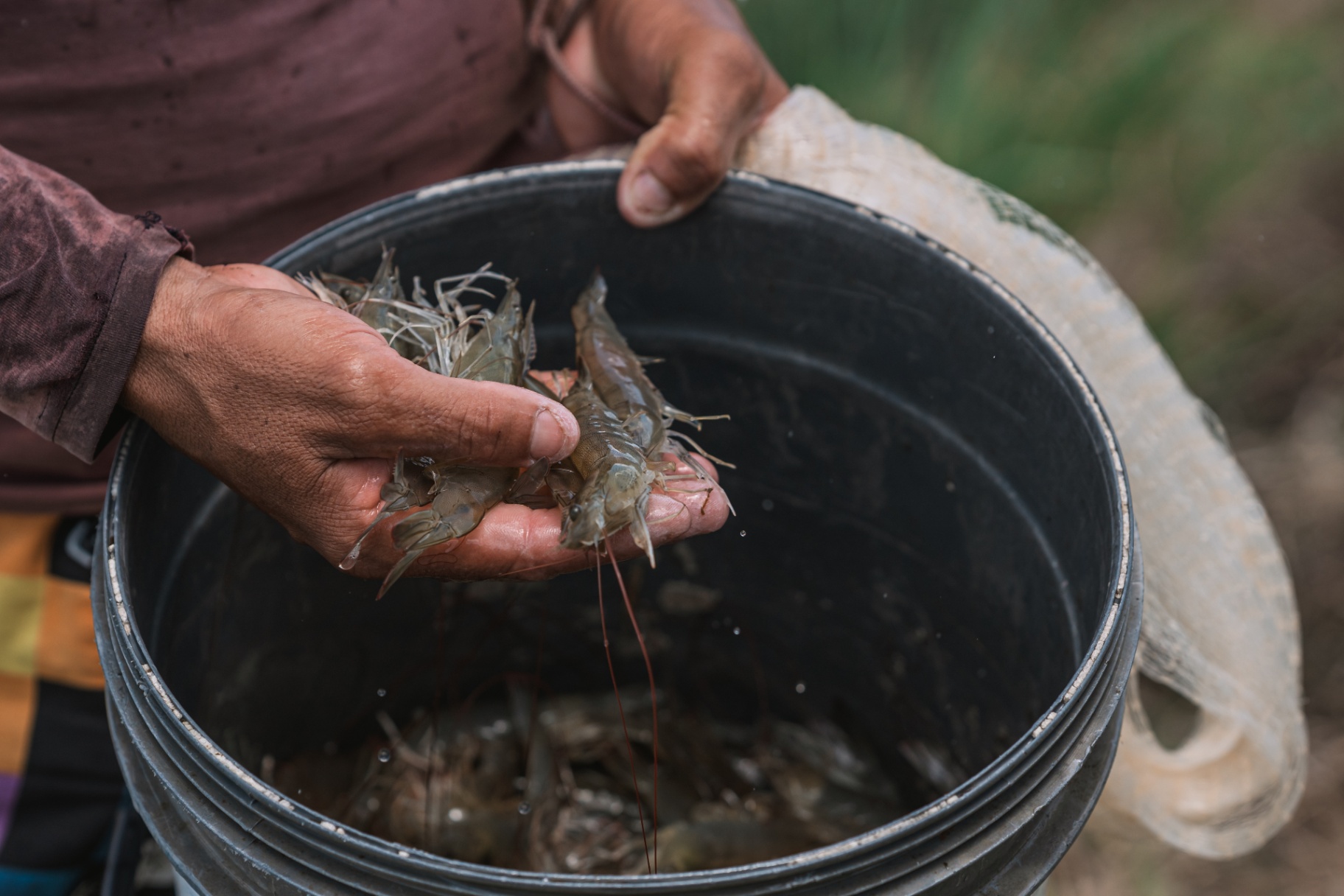
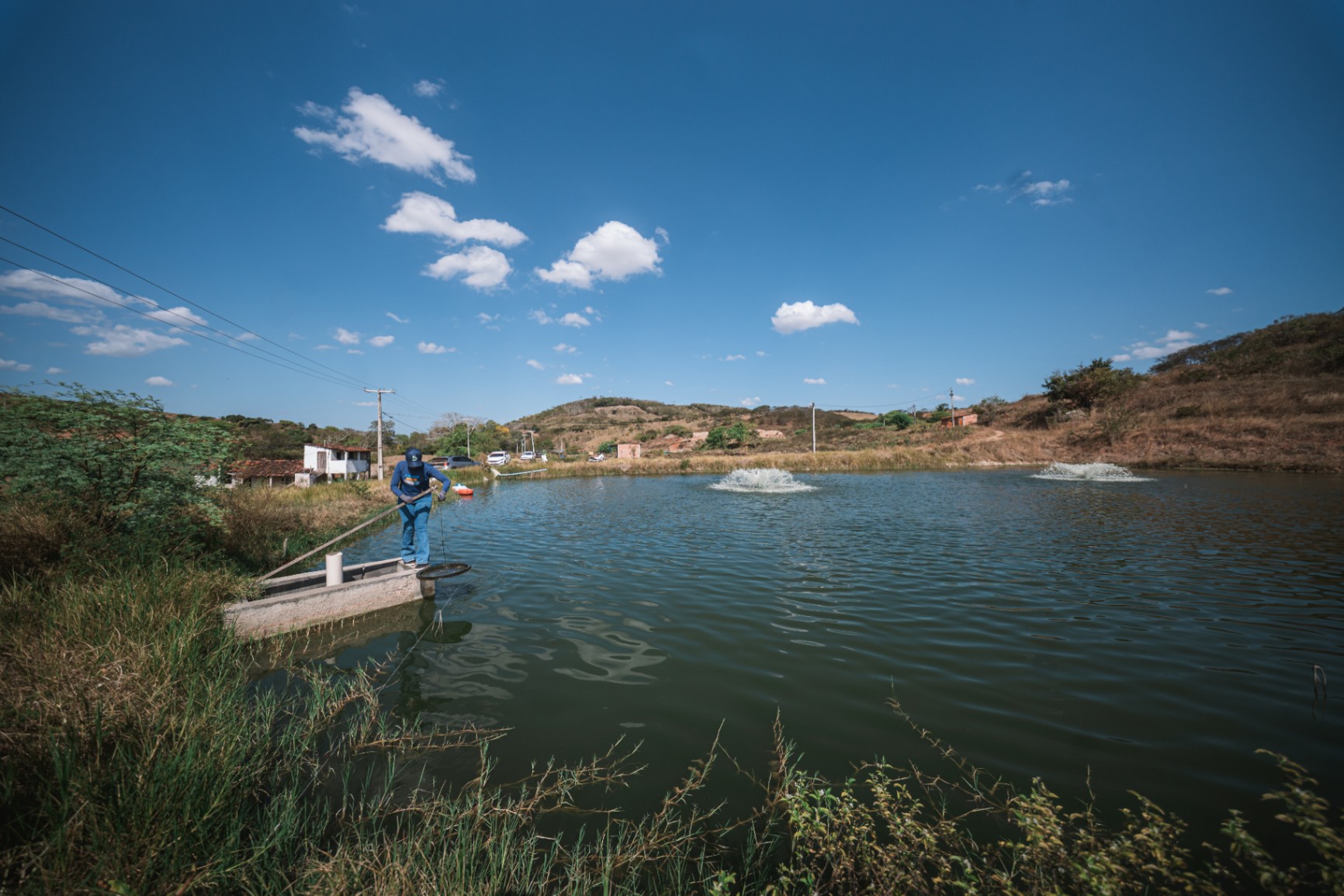
Shrimp production in the state of Alagoas tripled in five years due to a combination of technical knowledge, institutional support, and collective work. ©FAO/Julio Vasconcelos
Returning to the countryside through shrimp farming
Marinho Eduardo Martins grew up helping his father with subsistence farming near Arapiraca, the second-largest municipality in the state of Alagoas. The family cultivated cassava, beans, tobacco and especially pineapple, one of the few crops that thrive with the region’s brackish water. However, as farm yields were low, he moved to the city, where he spent more than ten years working in factories.
It was shrimp farming that brought Marinho back to the countryside, offering stability and future prospects. After joining a technical visit and witnessing the success of neighbouring producers, he decided to invest in the sector. “My father thought it wouldn’t work, that it was risky. He wanted to continue with pineapple. New things always create distrust,” he recalls.
Despite his family’s resistance, he persisted, convinced the business would succeed — and it did. “My life changed radically. Before, we were always just getting by; now, with shrimp farming, we have a stable income,” he explains. The two ponds on his property produce shrimp in cycles of 60 to 90 days, generating significant value for someone who once depended on unstable earnings.
With support from technical assistance services and the Association, Marinho improved his management practices and became a productivity reference in the region. Focused on monitoring water and soil conditions, he has achieved strong production results. “If you provide a healthy environment, shrimp will thrive. I use quality inputs, such as probiotics, and to this day I’ve had no losses — only gains,” he says proudly.
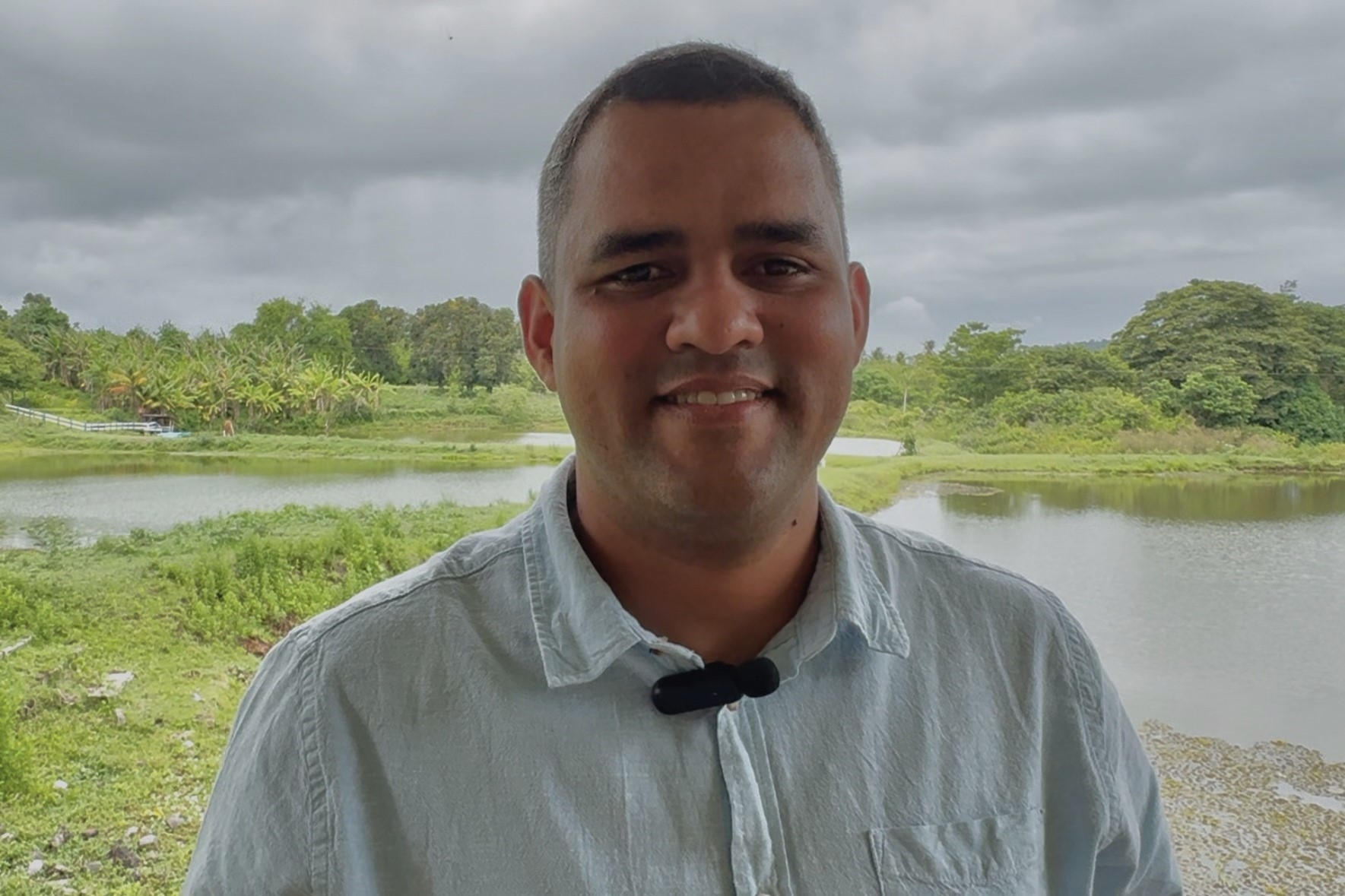
Iury Amorim provides digital technical assistance and guides producers on good management practices, acting as a bridge between technical knowledge and local knowledge. © FAO/Luiza Olmedo
The power of association
Fisheries engineer Iury Amorim was among the first to see shrimp farming as a viable alternative for development in Alagoas. After studying in southern Brazil, he returned to his hometown of Coité do Nóia and recognized in brackish water — common in the semi-arid region and unsuitable for irrigation or consumption — a resource with strong potential for marine shrimp production. Inspired by successful models in neighbouring northeastern states such as Rio Grande do Norte, he decided to build the first excavated pond on his family’s land.
The experiment drew community curiosity. “It looked like a parking lot, so many people came to see. Everyone wanted to know what it was,” he recalls. The pond worked, the shrimp grew healthy, and enthusiasm spread. With support from the local government and technical guidance, Iury mobilized other producers and founded the Alagoas Association. Today, as its president, he leads an organization that brings together more than 80 families, manages around 180 active ponds and produces over 1 000 tonnes of shrimp per year.
As a project extension officer hired by FAO, Iury also provides digital technical assistance and guidance on best management practices. He now serves as a bridge between technical knowledge and local experience. “Here, we make use of what no one wanted. Brackish water, once seen as a problem, has become the foundation of a family-based economy that is changing lives,” he says.
The experience gained over the years has also strengthened the association’s capacity for coordination. In addition to expanding production, Iury and other members have opened new marketing channels and created a collective structure for purchasing inputs, reducing costs and increasing producers’ autonomy. “Every new pond represents a family with income, dignity and hope,” he concludes.