


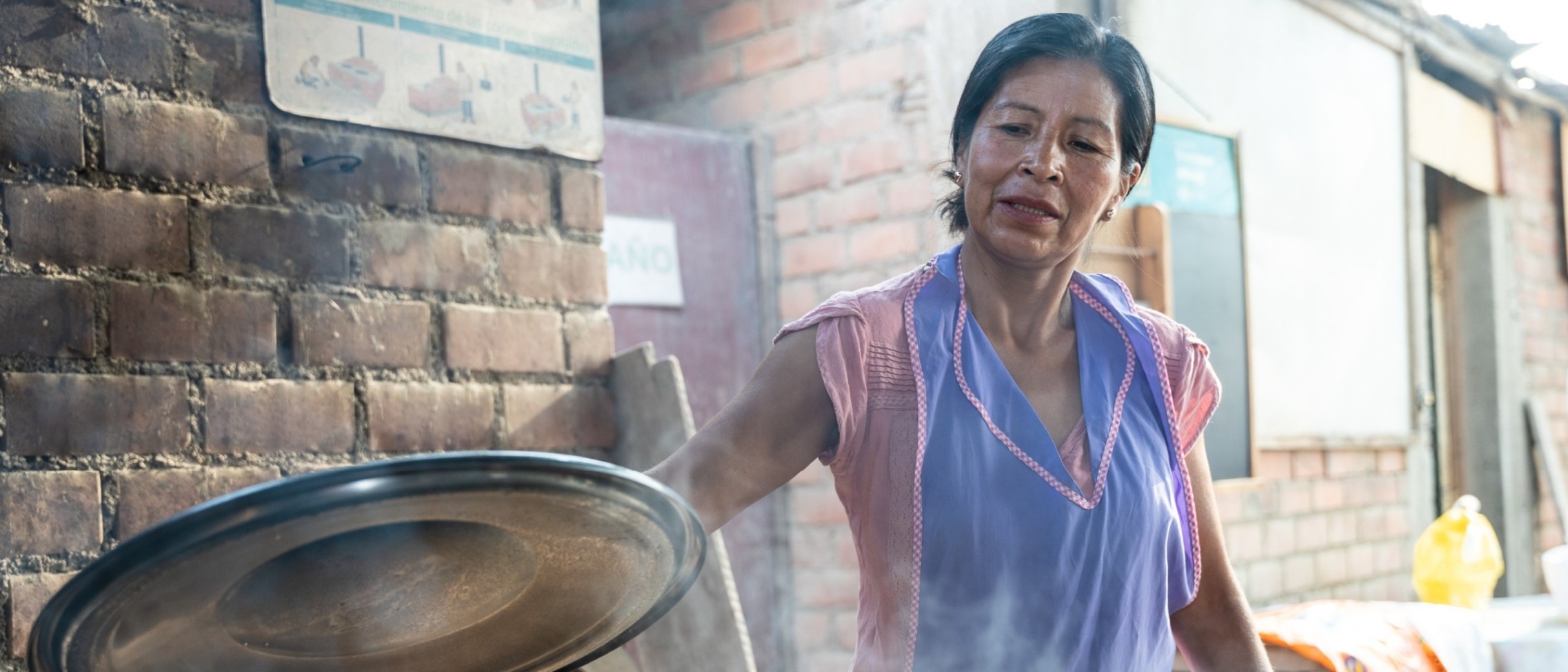
Women who feed with courage: the collective strength of community kitchens in Peru
From Manchay, women such as Yuly Rojas and Julia Ninahuamán are turning need into community organization. Together with the Pachacámac Community Kitchens Network and in coordination with FAO, their work has become a regional example across Latin America and the Caribbean in the fight for food security.


From the Pachacámac Community Kitchens Network (REDOPA), Yuly Rojas and Julia Ninahuamán, with technical support from FAO, are driving urban policies that are transforming the way food systems are built in Peru.
©FAO
23/06/2025
Yuly Rojas is slender, speaks softly and warmly, but behind her voice there’s a story shaped by struggle. She was born in Apurímac, and at the age of 10 she lost her father, who was killed by terrorism. Her mother, widowed at 28, raised her alone and passed away just a month ago. Today, Yuly, a mother of three, has moved forward with what she can: a small shop, her weaving, and above all, an enormous determination to never give up.
During the pandemic, her shop became a place to listen. Neighbors came to tell her they could no longer afford even rice or oil, that their husbands had lost their jobs, that they did not know how to feed their children. Yuly knew she could not stand idly by. She used her loudspeaker and called a meeting: “If we all bring a little, we can cook together”.
This is how the Manos Milagrosas (Miraculous Hands) community kitchen was born, starting with two pots, firewood, and a frying pan donated by the neighborhood parish priest.
Today, this kitchen feeds 70 people, including children with anemia, older adults, and people who are bedridden. Thanks to the Pachacámac Community Kitchens Network (REDOPA), they now have an improved smoke-free kitchen, a community garden with fresh vegetables, and a small laying-hen coop that strengthens the nutritional value of the meals. “People say everyone works for money, but I do this out of love, because I know what it means to suffer as a child. Sharing solidarity with your neighbor, that fills your soul”, says Yuly, her eyes moist but her voice firm.
.jpg?sfvrsn=874e3121_3 "Women who feed with courage: the collective strength of community kitchens in Peru")
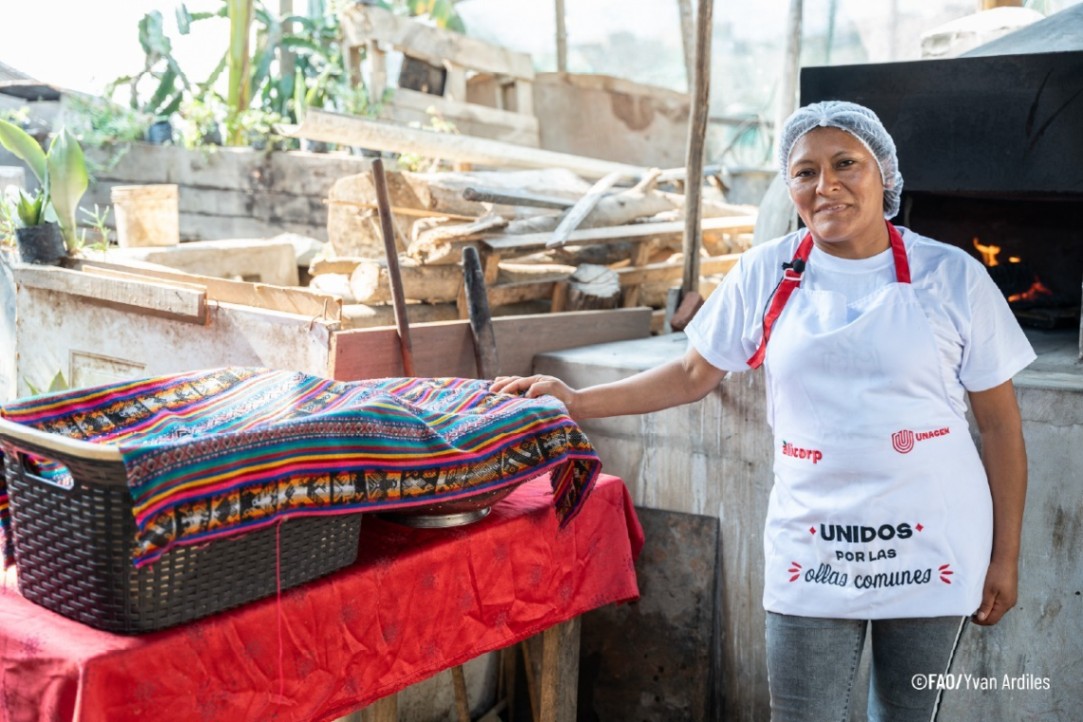
From the Pachacámac Community Kitchens Network (REDOPA), Yuly Rojas and Julia Ninahuamán, with technical support from FAO, are promoting urban policies that are transforming the way food systems are built in Peru. ©FAO/Yvan Ardiles
A few kilometers away, in another part of Manchay, lives Julia Ninahuamán. Originally from Cusco and the mother of five sons, she has always been an organized, proactive, and committed woman. She moved to Lima as a child, settled in the area more than 20 years ago, and together with her husband —whom she has known since childhood—, built a family that is her strength and her driving force. Julia was already involved in social work before the pandemic, but when the health emergency broke out and she saw that her neighbors lacked food, she took a bigger step.
She offered part of her home to establish the Villa Jesús community kitchen after they were denied access to the community center. Along with other mothers, she began cooking with whatever was available: rice, pasta, and recovered vegetables. They managed to feed more than 130 people a day. As the need grew, so did their capacity to respond. Today, her kitchen includes a community bakery that produces iron-fortified bread, a solidarity shop offering recovered fruits and vegetables, and a network of women who cook in an organized, rotating system with deep commitment. “Seeing such young children with anemia, so thin, is an open wound. But when we organize, things change. Feeding people is also a form of resistance”, Julia affirms.
Both Yuly and Julia are part of REDOPA, an organization that coordinates efforts to manage concrete and community-based solutions. Many of these actions have been strengthened through FAO’s sustained technical support, which has not only promoted spaces such as the Lima Metropolitan Food System Council (CONSIAL) but also supported the formulation and implementation of local food policies with a food-systems approach.
Working alongside them is Erico Tueroconza, originally from Ayacucho and a resident of Manchay for 17 years, who currently serves as REDOPA’s recording secretary. As a young man, he was an altar server and participated in pastoral groups, finding in faith his vocation for service. During the pandemic, he left his home and moved into the parish to coordinate distributions, manage supplies, and organize the district’s first community kitchen.
Since then, REDOPA has recovered more than one thousand tons of food from markets and farms in the valley through food recovery brigades. “What we were doing without knowing it, we later learned thanks to FAO Peru, was called recovery. And what began as an emergency is now a system,” says Erico proudly.
A continent that comes together, a future cooked from the ground up
.jpg?sfvrsn=d190b40c_3 "Women who feed with courage: the collective strength of community kitchens in Peru")
FAO Peru team, the Brazilian Cooperation Agency (ABC) and delegations from six countries in Latin America and the Caribbean during a visit to the Villa Jesús community kitchen. ©FAO/Yvan Ardiles
Since 2016, FAO has promoted an Urban Food Agenda to advance public policies with a food-systems approach in cities. In Lima, it led training processes and strengthened multi-stakeholder platforms, bringing together civil society, cooperation agencies, academia, and local governments. Thanks to this work, during the pandemic community kitchens were supported through the Food
Security Roundtable and later through CONSIAL. This model was also replicated in the Municipality of Pachacámac, consolidating previously nonexistent spaces for dialogue.
Today, community kitchens communicate directly with wholesale markets, peri-urban farmers, universities and research centers, and have consolidated their relationship with municipal and national authorities.
FAO has contributed to capacity development to implement strategies with a food-systems approach, generating continuous improvement processes that have had a direct impact on territorial management. One of the most significant achievements has been its influence on public policy. This coordination enabled the approval of regulations such as the municipal ordinance on food recovery in wholesale markets, which later scaled up to the national level and became law. Likewise, it played a very important role in the approval of the Food Security Law and the Community Kitchens Law.
In addition, FAO has made the work of community kitchens more visible through communication strategies, recognition by local governments and parliament, as well as incentives such as the Food Loss and Waste (FLW) Award, granted to REDOPA in 2021 and 2025 for its work in food recovery from markets and farms. These actions have helped connect local experiences with other municipalities, regional platforms and even international networks, strengthening the exchange of knowledge and practices.
In a continent where more than 40% of the population lives with food insecurity, cooperation between countries and the strengthening of networks such as REDOPA are essential. And in places like Manchay, thanks to the capacities developed in urban food policies promoted by FAO, women are no longer just cooking: they lead, manage and transform food systems.