


Edition: 4 to 29 December 2023
 ©fao/Asfri Rangkuti | ASIA AND THE PACIFIC Strengthening animal health cooperation in Southeast Asia: Malaysia takes a significant step towards the ASEAN Coordinating Centre for Animal Health and Zoonoses After more than a decade, the ASEAN Coordinating Centre for Animal Health and Zoonoses (ACCAHZ) was operationalized with the 1st ACCAHZ Governing Board meeting held in the ACCAHZ office, Sepang, Malaysia, on 12–13 December 2023. FAO, through the SMART-ASEAN project funded by the Australian Government, attended the meeting as a Centre associate member. The meeting focused on the launch plan, ACCAHZ’s five-year strategic work plan and resource mobilization. Chief Veterinary Officers/Director-Generals from Brunei Darussalam, Cambodia, Indonesia, Lao People’s Democratic Republic, Malaysia, Singapore, Thailand and Viet Nam participated. Read more here. |
 ©fao/Saskia Soedarjo | INDONESIA Launch of the National Zoonoses and Emerging Infectious Diseases Information System On 19 December 2023, The Coordinating Ministry for Human Development and Cultural Affairs (CMHDCA), together with various Indonesian ministries, FAO, World Health Organization (WHO), United States Agency for International Development (USAID) and Indonesia One Health University Network (INDOHUN), launched the National Zoonoses and Emerging Infectious Diseases Information System (SIZE National). The integrated system aims to address the increasing threat of zoonoses such as rabies, anthrax, avian influenza and several other zoonotic diseases. SIZE National is designed to swiftly detect and respond to new infectious diseases with the potential to become an extraordinary event, an outbreak, or even a pandemic. Coordinating Minister for Human Development and Cultural Affairs Muhadjir Effendy emphasizes the effectiveness and precision of controlling zoonotic diseases through SIZE National, resulting in a more accurate control strategy. He also expressed appreciation to FAO and other development partners for their contributions. |
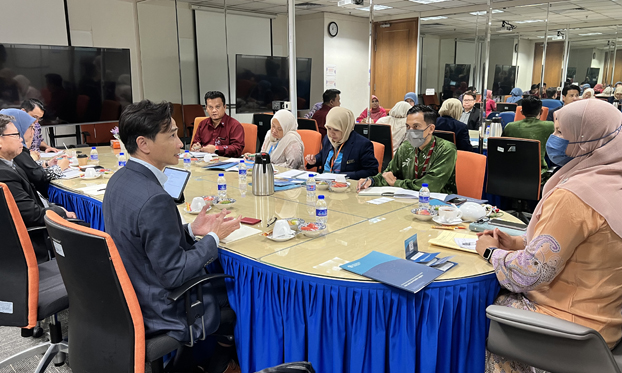 ©fao/ASFRI RANGKUTI | ASIA AND THE PACIFIC Discussion on potential collaboration for amplifying Malaysia's animal health capabilities On 14 December 2023, FAO ECTAD Regional Manager Kachen Wongsathapornchai discussed potential collaboration with Siti Salwahanim binti Mohd Nazir, Undersecretary for International Division, Ministry of Agriculture and Food Security. The focus is on strengthening Malaysia's animal health capabilities for sustainable agriculture and food security. The meeting explored strategies to enhance Malaysia's veterinary capacity, surveillance and regional cooperation through an FAO project. This partnership aims to leverage FAO's expertise to support Malaysia in building resilient and healthy livestock populations, contributing to secure and sustainable animal health future. |
Learn more about our partnerships here.
| |
 ©fao//Asif Jilani | BANGLADESH Collaborative efforts against AMR: inception workshop for Multi-Partner Trust Fund FAO, World Organisation for Animal Health (WOAH), United Nations Environment Program (UNEP) and WHO jointly organized an inception workshop in Dhaka on 12 December 2023 for a Multi-Partner Trust Fund (MPTF) project aiming to combat AMR in Bangladesh. The project involves government stakeholders and follows a One Health approach. During the workshop, development partners shared detailed information on the activities and received feedback from the government and discussed coordinated implementation. The MPTF project supports multiple government agencies, including the Department of Livestock Services, Department of Fisheries, Ministry of Fisheries and Livestock, Directorate General of Health Services, Directorate General of Drug Administration, Ministry of Health and Family Welfare and Ministry of Environment and Forestry in addressing AMR through multisectoral coordination. |
 ©FAO Cambodia | CAMBODIA Consultative workshop on revising Cambodia’s AMR Multi-Sectoral Action Plan FAO, World Bank and Deutsche Gesellschaft für Internationale Zusammenarbeit (GIZ) co-organized a two-day workshop to revise Cambodia’s Antimicrobial Resistance Multi-Sectoral Action Plan (MSAP) 2024-2028, funded by USAID. The workshop, held on 11 and 12 December 2023, assessed progress under the MSAP 2019-2023 and planned for the new MSAP. With 54 participants, including 12 women, the workshop involved key ministries and international partners, emphasizing Cambodia’s commitment to tackling AMR through a holistic, integrated approach, encapsulated by the One Health framework. The workshop produced fruitful outcomes that will continue to play a pivotal role in tackling AMR, one of the most pressing global health threats, within the framework of the new MSAP.
|
 ©FAO/Gunawan Utomo | INDONESIA Advocacy and on-site visit for RENOFARM pilot in East Lampung On 19-20 December 2023, FAO Indonesia conducted an advocacy and on-site visit with FAO headquarters and the Directorate of Animal Health, Ministry of Agriculture, for the FAO’s Reduce the Need for Antimicrobials for Sustainable Agriculture Transformation (RENOFARM) pilot implementation in East Lampung District. The visit included an advocacy meeting to gain local commitment and support for addressing the challenges and gaps in the programme’s implementation. Participants included key stakeholders from various offices, poultry farmers and industry representatives, and facilitators of Farmer Field School (FFS) of the RENOFARM pilot. |
-advisory-board-meeting.jpg?sfvrsn=1a52c302_1) ©FAO ECTAD India | INDIA The tenth Indian Network for Fishery and Animal Antimicrobial Resistance (INFAAR) Advisory Board meeting On 22 December 2023, FAO and Indian Council of Agricultural Research (ICAR) facilitated the tenth Indian Network for Fishery and Animal Antimicrobial Resistance (INFAAR) Advisory Board meeting, chaired by Deputy Director General Dr JK Jena. With 12 senior officials present, the meeting reviewed INFAAR data, planned 2024 activities and identified tasks for principal investigators (PIs). Solutions for a strategic technical framework were proposed, emphasizing the need to enhance PIs’ human resources and laboratory capabilities to carry out mandated AMR surveillance activities for INFAAR. Additionally, the Advisory Board emphasized the importance of conducting genomic AMR surveillance. |
 ©FAO/Surendra Karki | NEPAL Awareness programme on AMR conducted in Janakpur FAO, with USAID support, conducted three awareness workshops in Janakpur on 8-9 December 2023. Nearly 100 participants from public and private veterinary practitioners, animal health technicians and agrovets (veterinary pharmacies) attended, including the presence of Director-General of Department Livestock Services (DLS) Umesh Dahal. During the workshop, a technical presentation on an overview of AMR and its patterns based on the data generated at the Veterinary Laboratory in Janakpur was presented to the participants highlighting the need for rational use of antimicrobials at the field level and the need for a One Health approach to tackle the growing threats of AMR. |
Learn more about our work on AMR here.
| |
 ©fao/rINDU pUTRI | ASIA AND THE PACIFIC AND CAMBODIA Innovative disease surveillance in Cambodia
In early 2023, FAO ECTAD in Asia and the Pacific started an innovative project in Cambodia, receiving an FAO innovation grant for environmental sampling. The Drone Pirates team, led by Filip Claes and Erik Karlsson, shared their year-long progress, challenges and impacts during the FAO's incubation programme pathway on 14 December 2023. They showcased their work using drone air samplers and metagenomics for disease surveillance and diagnosis, aiming to respond to outbreaks and prevent potential pandemics originating from animals. The team's efforts focus on supplementing traditional surveillance methods with environmental sampling, extending to remote locations using cost-effective, rapid and safe techniques for continuous surveillance data. Moving forward, FAO will complete analysis of pathogen surveillance in Cambodia as the pilot programme. FAO will also deploy this innovative surveillance system to other high-risk countries in the region. |
 ©FAO PHILIPPINES | THE PHILIPPINES Coordination meeting and simulation exercise for animal disease emergencies FAO and the Bureau of Animal Industry (BAI) held a coordination meeting and simulation exercise for animal disease emergencies, highlighting avian influenza (AI) and FMD, in Davao City from 4 to 7 December 2023. The meeting focused on discussing animal disease preparedness and control, including the gaps and good practices implemented in the region. A simulation exercise and pop quiz assessed participants’ preparedness and current knowledge about the diseases. Experts and veterinarians who were part of the FMD eradication programme in the Philippines were invited to share their experiences. Moreover, the BAI’s AI vaccination guidelines were also discussed. The growing concerns of Henipavirus was included to increase awareness about this priority zoonotic disease, given that the 2014 outbreak in the country was reported in Mindanao. The week-long activity involved various institutions and was funded by USAID.
|
 ©FAO ECTAD India | INDIA INFAAR’s annual review to improve AMR surveillance
On 23 December 2023, the sixth annual review meeting addressed critical issues faced by the INFAAR network in AMR surveillance. Chaired by the Deputy Director-General of the Indian Council of Agriculture Research Dr JK Jena, principal investigators from 21 INFAAR centres participated, along with specialists from USAID, Indian Council of Medical Research and FAO. Under the strategic framework of AMR mitigation, the animal health component is undergoing significant revision. The meeting emphasized revising the animal health component under the AMR mitigation framework, focusing on pan-India data on AMR from all states and strengthening the INFAAR network by adding surveillance and advocacy centres. |
Learn more about our work on surveillance here.
| |
 ©FAO/sURENDRA KARKI | NEPAL AND ASIA AND THE PACIFIC Enhancing epidemiological capacity: FAO assesses Nepal’s veterinary services FAO, through USAID funding, assessed epidemiological capacity of Nepal’s veterinary services using the Epidemiology Mapping Tool (EMT). A team of three experts from the FAO Regional Office for Asia and Pacific led by Peter Black conducted the assessment along with the team from the DLS and FAO from 10 to 18 December 2023. The mission identified important gaps in the reporting system, workforce and other institutional arrangements. Recommendations and priority actions will be provided to address these gaps. |
| Learn more about our work on epidemiology here. | |
 ©FAO/Saskia Soedarjo | INDONESIA Knowledge-sharing on high-impact infectious animal diseases in Tana Toraja On 7 December 2023, the Indonesian Ministry of Agriculture, FAO ECTAD and the South Sulawesi provincial government held an event in Tana Toraja, South Sulawesi Province. The event provided technical guidance on high-impact infectious animal diseases, such as rabies, African swine fever (ASF), lumpy skin disease (LSD), foot-and-mouth disease (FMD), and Jembrana to animal health officers, livestock and agricultural extension officers. During the event, FAO provided technical guidance specifically on the topic of ASF to increase the knowledge of participants on ASF prevention, biosecurity measures and control. The event aimed to enhance knowledge of the participants to respond effectively to animal disease outbreaks and share relevant information with farmers in the field. |
 ©FAO/Andri Jatikusumah | INDONESIA Enhancing disease control and awareness in South Sulawesi In a joint effort supported by the Australian Government, FAO and the Directorate General of Livestock and Animal Health Services visited South Sulawesi from 14 to 15 December 2023. The visit aimed to provide technical support for controlling FMD and raising awareness on FMD and other priority diseases, such as LSD and Jembrana, through effective risk communication. The two-day visit involved more than 730 participants from 23 districts in South Sulawesi. These sessions served to educate farmers on disease recognition, impacts, preventive measures, and emphasized vaccination and health management programmes for livestock. A side meeting with the Chief Veterinary Officer and local officials from Bone Animal Health Office and Maros Disease Investigation Center were organized to formulate a follow-up action plan for the FMD vaccination programme. |
Learn more about our work on capacity development here.
| |
 ©FAO/Surendra Karki | NEPAL Training on sample collection, dispatch and epidemiological reporting FAO, with USAID support, conducted a two-day training on sample collection, dispatch and epidemiological reporting at the Veterinary Laboratory in Janakpur during 7-8 December 2023. Twenty animal health technicians from Parsa District participated, and Dr Umesh Dahal, Director-General of the DLS distributed sample collection kits. The training was organized in collaboration with the DLS, Central Veterinary Laboratory, and Veterinary Laboratory in Janakpur. |
| Learn more about our work on capacity development of laboratory here. | |
RISK COMMUNICATION
 ©FAO/Eko Prianto | INDONESIA Risk communication event on high-impact infectious animal diseases and zoonoses From 27 to 29 December 2023, FAO and the Directorate General of Livestock and Animal Health Services visited Bone District in South Sulawesi, thanks to the Australian Government for the funding support. The visit aimed to conduct FMD and LSD risk communication and identify challenges for its control strategies. It involved over 300 farmers and supported by Bone District Livestock and Animal Health Services and Disease Investigation Center Maros. The meetings discovered four priority infectious animal diseases in the district—anthrax, Jembrana, FMD and rabies—along with plans for LSD preparedness, which has not yet entered Sulawesi. |