


The International Day of Awareness of Food Loss and Waste - 2025
Thursday 23 October 2025, 10:00 AM – 1:00 PM (GMT+3)
Cairo (Egypt), Hybrid Event, 23/10/2025
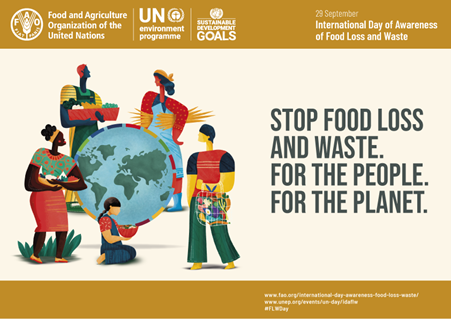
The International Day of Awareness of Food Loss and Waste - 2025
Background
As the Food and Agriculture Organization of the United Nations (FAO) marks its 80th anniversary under the global theme “365 Days of Action”, addressing food loss and waste (FLW) remains a critical priority for transforming agrifood systems; both globally and in the Near East and North Africa (NENA) region.
Globally, approximately 13 percent of food, equivalent to 1.25 billion tonnes, is lost between harvest and retail1. An additional 19 percent, 1.05 billion tonnes, is wasted at the consumption stage, with households accounting for nearly 60 percent of global food waste2. These figures are particularly alarming in light of the 2.33 billion people who experienced food insecurity in 2023, including one in eleven people facing hunger3. Moreover, FLW contributes to 8–10 percent of global greenhouse gas emissions, exacerbating climate change and placing further strain on natural resources.
In the NENA region, the challenge is further intensified by regional vulnerabilities. An estimated 15 percent of food is lost between post-harvest and retail, while up to 32 percent of FLW occurs at the consumer level. In high-income countries of the region, such as those in the Gulf Cooperation Council (GCC), household food waste can reach 75 to 163 kilograms per capita annually4,5. Perishable commodities—including fruits, vegetables, dairy, meat, and fish—are particularly affected, with over 30 percent wasted each year. These losses represent not only a missed opportunity to enhance food security but also a significant depletion of the region’s already scarce natural and economic resources.
Reducing FLW is among the most cost-effective and impactful strategies for transforming agrifood systems. It contributes to reducing methane emissions, conserving land, water, and energy, and promoting more equitable food distribution. Furthermore, valorizing food processing by-products can enhance the economic, social, and environmental sustainability of food systems, while supporting the transition to circular economy models6.
However, no single actor can address FLW alone. Coordinated, multi-stakeholder action is essential—engaging governments, civil society, the private sector, consumers, researchers, and academia. Effective solutions require collaboration across the food supply chain, strengthened networks, awareness-raising, inclusive dialogue, and the scaling up of proven practices. In the NENA region and beyond, collective action is key to achieving meaningful progress in reducing food loss and waste.
Rational
Tackling FLW across the agrifood value chain, from production to consumption, can significantly improve the efficiency, sustainability, and resilience of food systems, helping ensure that more food reaches those in need.
Recognizing the urgency of this global challenge, the United Nations General Assembly adopted Resolution 74/209 on 19 December 2019, designating 29 September as the International Day of Awareness of Food Loss and Waste (IDAFLW). This annual observance serves as a global call to action, encouraging governments at all levels, the private sector, civil society, and individuals to intensify efforts to reduce FLW and enhance food security7.
This year, the NENA region once again joins the global community in commemorating IDAFLW. The Day highlights the need for coordinated, multi-stakeholder action—as no single actor can address FLW alone. In this context, the FAO Regional Office for the Near East and North Africa (FAO-RNE) has convened a diverse group of stakeholders whose commitment and innovative approaches reflect the growing recognition of FLW as a shared responsibility and a key entry point for transforming agrifood systems for better production, better nutrition, a better environment, and a better life, leaving no one behind.
Objectives
To mark the IDAFLW 2025, the FAO-RNE is organizing a regional awareness-raising workshop. This year’s observance provides an opportunity to:
Highlight the importance of addressing FLW as a critical component of agrifood systems transformation in the NENA region;
Showcase innovative tools and approaches, including the Food Loss Appraisal Tool (FLAPP) and OPTIWASTE, developed by regional and global actors to reduce FLW;
Identify opportunities for strategic and technical collaboration to scale up impactful solutions and strengthen regional cooperation.
Participants and Speakers
FAO Regional Office for the Near East and North Africa (FAO-RNE) Officials,
League of Arab States (LAS),
FAO Technical Platform on the Measurement and Reduction of Food Loss and Waste representatives,
Member country's representatives,
Private sector representatives, consumer organizations and academia.
Format
The format for the co-organized regional celebration is an interactive hybrid meeting with simultaneous interpretation (Arabic and English). The workshop will be opened by the FAO Assistant Director-General and Regional Representative for the Near East and North Africa and the representative from LAS followed by short dialogue sessions by invited speakers and participants.
Tentative Agenda and Program
When: 23 October 2024, 10:00 AM – 01:00 PM (GMT+3).
Modalities: Hybrid Event | RNE (Conference Room).
Time | Subjects | Speaker |
Opening Session and Remarks | ||
10:00-10:05 (5 min) | Moderator’s welcome and event guide | FAORNE Moderator |
10:05-10:20 (5 min each) | Opening Remarks: Objectives and desired outcomes of the event. | Dr. Abdulhakim Elwaer, Assistant Director General and Regional Representative, FAO Regional Office for the Near East and North Africa. |
Nada El Agizy, Minister Plenipotentiary | ||
Dr. Rolle Rosa, Former Senior Enterprise Development Officer, and Team Leader FLW, ESN | ||
10:20-10:30 (10 min) | Setting the Scene: Regional priorities and challenges to ensure fast exchange of information and actions to improve collaboration in FLW reduction. | Dr. Ahmad Mukhtar, OiC Regional Programme Leader, FAO Regional Office for the Near East and North Africa |
New technologies and approaches | ||
10:30-10:45 (15 min) | FAO support and initiatives to fight FLW in the NENA Region | Dr. Moustapha Mohamed, Food Safety and Quality Officer, |
10:45-11:00 (15 min) | Presentation of the FAO’s OPTIWASTE application to support FLW monitoring and reduction | Dr. Luciana DelgadoOtero, Technical Adviser, DDCG
|
11:00-11:15 (15 min) | Africa Circular Economy Facility (ACEF) as an accelerator for the transition to a circular economy in Africa
| Ms. Balgis OSMAN-ELASHA Chief Climate Change & Green Growth Officer
|
11:15-11:30 (15 min) | Ne’ma initiative in scaling food rescue programme in the UAE |
|
11:30-11:45 (15 min) | Presentation on the LAS law and legal framework to regulate and fight against food supply chain losses | Dr. Wadid Erian, |
11:45-12:00 (15 min) | Presentation on the support of circular packaging in the reduction of FLW. | Dr. Sara Jackson, |
12:00-12:20 (20 min) | Q&A session | |
Discussion | ||
12:20-12:35 (15 min) | How can collaboration between the different stakeholders be strengthened to reduce food loss and waste? | FAORNE Moderator |
12:35-12:45 (10 min) | Recap of key reflections, closing remarks, and acknowledgments. | Dr. Ahmad Mukhtar, OiC Regional Programme Leader, FAO Regional Office for the Near East and North Africa |