


FAO organizes training workshop “Designing and implementing livestock disease surveillance” in the United Arab Emirates
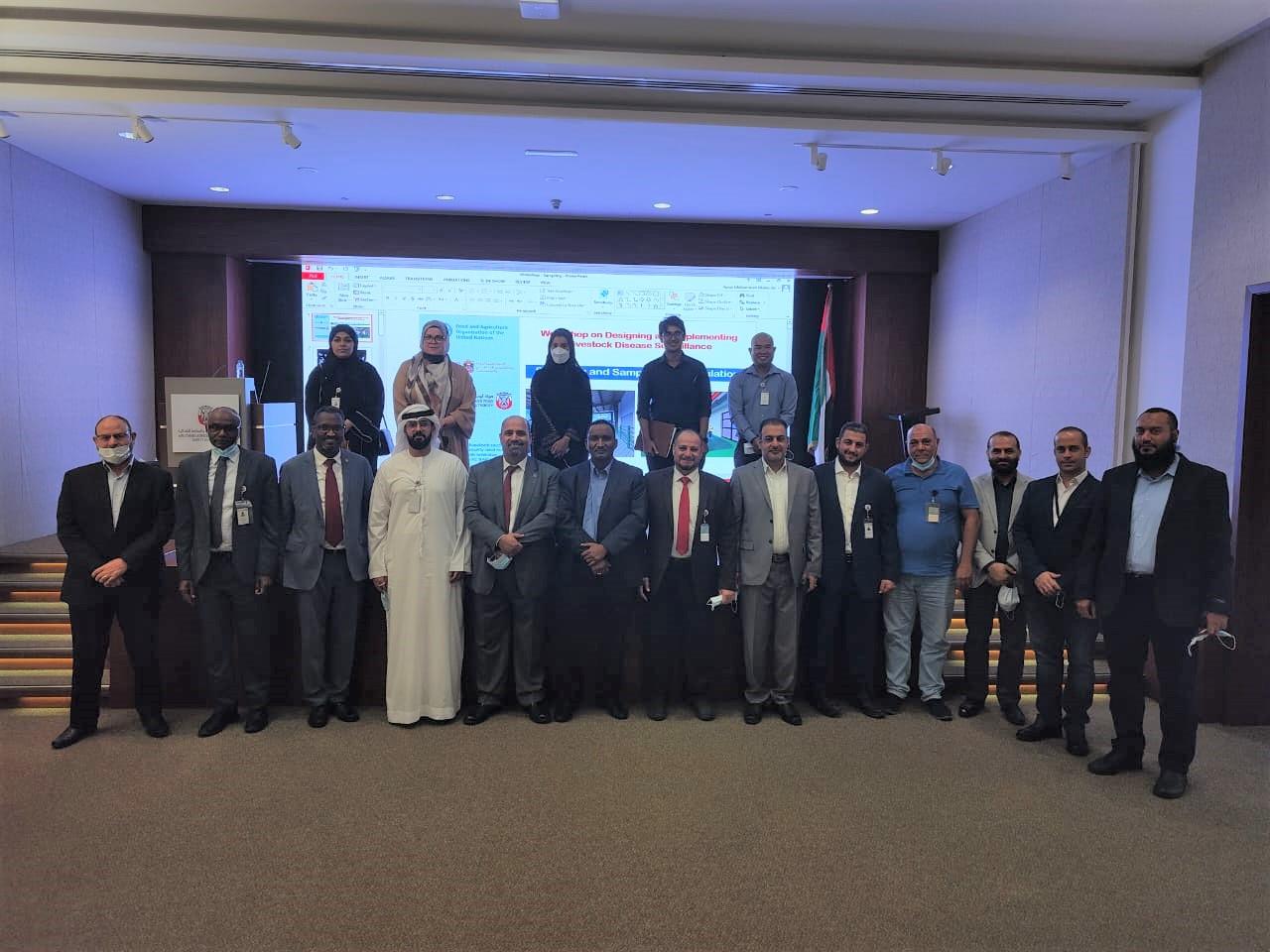
Abu Dhabi, 27 June 2022 – In collaboration with the Abu Dhabi Agriculture and Food Safety Authority (ADAFSA), The Subregional Office of the Food and Agriculture Organization of the United Nations (FAO) for the Gulf Cooperation Council States and Yemen organized a workshop at ADAFSA headquarters to build the national capacity of public veterinarians in animal disease surveillance and outbreak investigation. Such capacity building will strengthen the veterinary services and early warning systems to reduce risks associated with transboundary animal diseases (TADs).
The aim of the workshop is to train national expert to control or eradicate Transboundary Animal Diseases (TADs) through an efficient surveillance and outbreak investigation systems. Transboundary Animal Diseases (TADs) are among the most important constraints as they negatively impact trade and result in huge economic losses.
Never the less, The livestock sector in United Arab Emirates, as well as other countries in the Middle East region is suffering from TADs due to the huge losses associated with non-tariff sanitary barriers for livestock trade. TADs can be controlled through various measures such as movement control, stamping-out, slaughter or pre-emptive slaughter, import or export restrictions, zoning or compartmentalization, herd accreditation, isolation and quarantine, cleaning and disinfection, vector and reservoir control, treatment of products and by-products, vaccination and other medical measures. Countries are required to formulate and implement risk-based strategic plans (RBSP) to identify hotspots, to implement surveillance, and to implement recommended TADs control methods. The established RBSP should be in accordance with the Global Eradication Plans that are jointly formulated by FAO and the World Organization for Animal Health (WOAH, formerly OIE).
Dr Markos Tibbo, Senior Livestock Development Officer at FAO Subregional office stated that “the implemented workshop at ADAFSA has built the capacity of 22 public veterinarians in epidemiological surveillance, questionnaires design, sampling, outbreak investigation and reporting, and subsequently apply the knowledge gained in the field”. He also added that “FAO Subregional Office is working with several GCC countries to strengthen their capacity in early detection and response by formulating preparedness and contingency plans that can be employed in case of unexpected disease outbreaks”.
Both ADAFSA and FAO agreed to implement more training workshops and field simulations to strengthen the public veterinary authority’s early warning system and improve diagnosis, early response and recovery processes when faced with an emerging or re-emerging livestock disease.
Contact
MEDIA CONTACT
Sub-regional Communication Office for the GCC states and Yemen
Subregional Office for GCC States and Yemen for the Food and Agricultural Organization of the United Nations / MOCCAE building P.O. Box 62072, Abu Dhabi, United Arab Emirates | www.fao.org/neareast