


Signing Ceremony of four projects between Tunisia and FAO at the Ministry of Agriculture of Hydraulic Resources and Fisheries
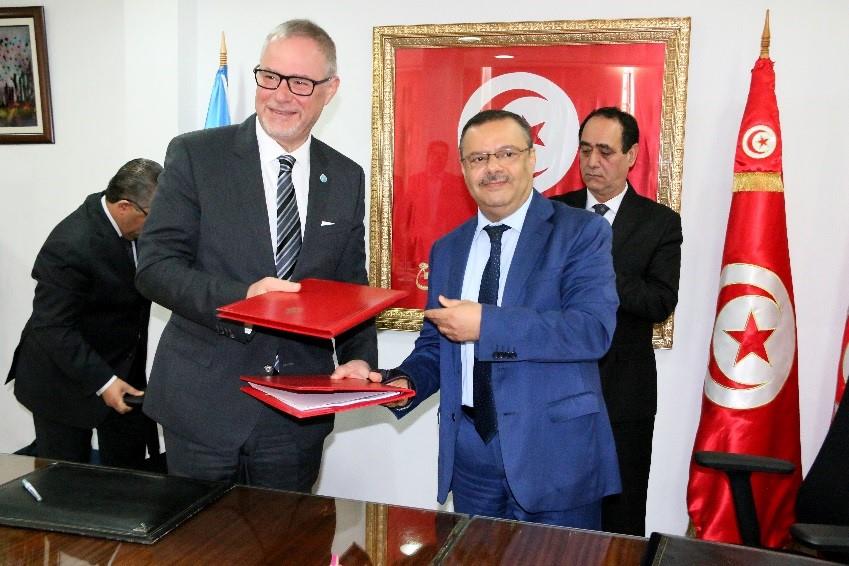
Tunis: Mr Samir Taieb, Minister of Agriculture of Hydraulic Resources and Fisheries, and Mr Michael Hage, FAO Coordinator for North Africa and Representative for Tunisia, signed three projects and a Tripartite South-South Cooperation Agreement during a ceremony at Ministry headquarters today. Through these signatures, FAO is strengthening its technical support and continuing to support the country in achieving the Sustainable Development Goals while also meeting the priorities of the national agricultural sector. Key sectors such as water, irrigation, olive oil and agricultural development occupy a prominent place in the activities and programs to be implemented.
The project on promoting solar energy for irrigation will reduce the cost of irrigation and make it more accessible to farmers so that they can increase their agricultural production and productivity. This project aims to realize the potential and manage the risks of solar irrigation for selected countries, namely Egypt, Jordan and Tunisia. This solar-powered irrigation technology has several advantages over fossil-fueled systems and is characterized by zero greenhouse gas emissions and relatively low operating and maintenance costs. The technical assistance that will be provided aims to strengthen institutional capacities through the sharing of experiences to understand how to promote and regulate the use of this solar technology for irrigation. Policy dialogue between sectors will be favored to ensure a coordinated approach, improve the management of natural resources and encourage low-carbon and climate-smart agriculture. Finally, technical experts will benefit from training to empower them to act as multipliers of knowledge. The budget for this project is 276,000 USD.
Another project related to the productivity and sustainability of water in the Near East/North Africa region was also signed. It concerns Egypt, Jordan, Lebanon, Morocco, Tunisia, Algeria, Iran and Palestine. Funded by the Swedish International Development Cooperation Agency with a budget of USD 10,153,938, this is part of the implementation of the 2030 Agenda, including Sustainable Development Goal 6.4 on water efficiency and productivity. Its goal is to empower countries technically, institutionally and politically to implement their water sustainability, food security, renewable energy and climate resilience agendas. The expected impact is to enhance food security through increased incomes and production, efficient and sustainable use of water resources and reduction of the carbon footprint of agriculture.
The third project signed is a Technical Cooperation Project (TCP) and has a budget of 300,000 USD. The technical assistance that will be provided by FAO will help support the Tunisian government in the development of a prospective and an olive oil strategy to 2030 that includes the production continuum on all links in the global value chain to the market. Mapping and an extension plan for olive growing will be developed, taking into account the agro-ecological potential of the areas identified for better adaptation to climate change. A Sector Investment Plan for 2020-25 will also be formulated. Finally, the training center created and administered by the National Office of Oil will be strengthened to support the improvement in the quality of olive oil, and promote capacity building in terms of extension in the olive sector.
Signature of a Tripartite Agreement for South-South Cooperation between Morocco and Tunisia
Exchange and mutual sharing of development solutions
The signing of this Tripartite Cooperation Agreement is funded by the South-South Cooperation Trust Fund, the Framework Agreement which was signed between FAO and Morocco in April 2014. The development and implementation of the Action Plan will be the subject of collaboration between FAO, Morocco and Tunisia. The fundamental objective of such cooperation is to exchange and share development solutions that will help Tunisia to identify, develop and implement activities related to agricultural development, improved food security and the fight against poverty, in particular through the creation of productive employment in agriculture. The technical assistance to be defined will concern the valorization of the agricultural products, the development and the promotion of the agricultural firms; biotechnology in the valorization of agricultural products; the use of renewable energies in the fields of dairy production, processing and packaging of agricultural products. It will also concern strengthening local capacities in order to develop quality products, to ensure added value and to guarantee the commercialization by referring to the Moroccan experience in the development of mountain products (the case of saffron).