


Using Water Accounting in the NENA region: Strengthening capacities in Jordan, Lebanon and Palestine
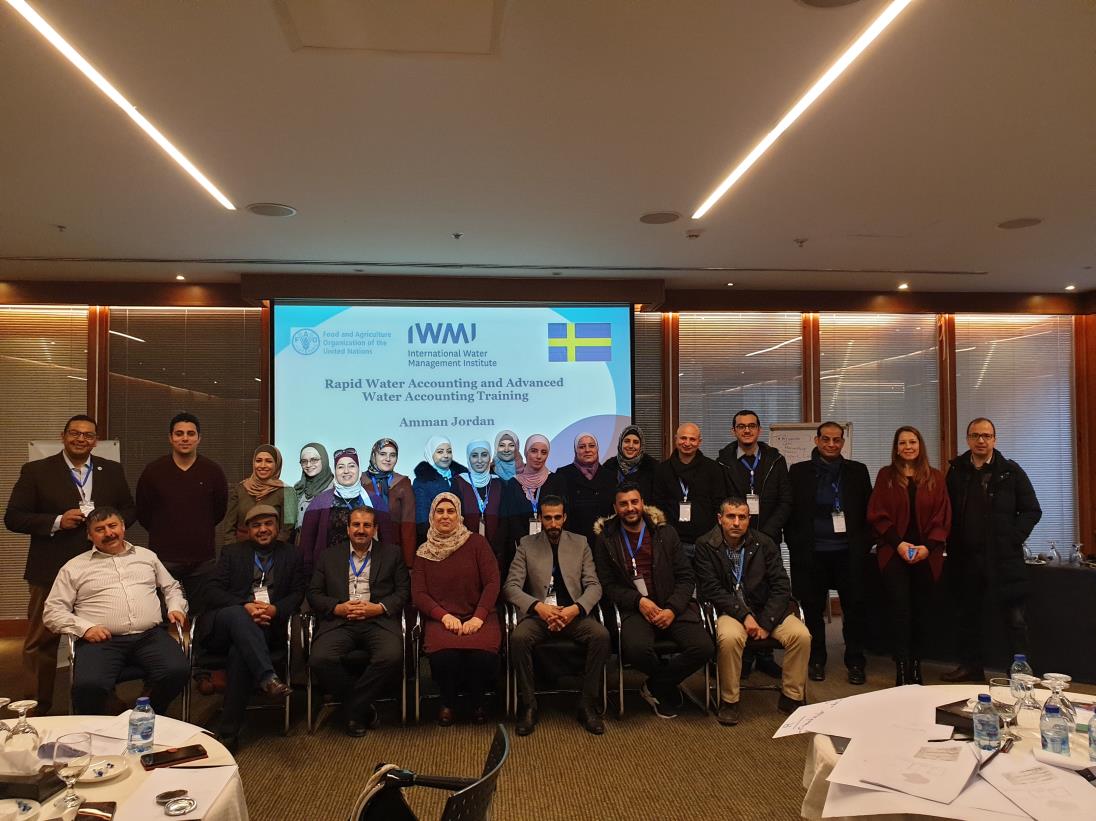
Training program participants in Jordan.
February 2020 – The Food and Agriculture Organization of the United Nations (FAO), in collaboration with International Water Management Institute (IWMI) and the national governmental organizations managing water resources in the participating countries, organized and successfully completed a training program for 40 participants in Jordan and Lebanon on Rapid and Advanced Water Accounting, as well as a national water accounting workshop in Palestine, where 40 participants attended. This activity falls within the project ‘Implementing the 2030 Agenda for water efficiency/productivity and water sustainability in NENA countries’, implemented by FAO with funding from the Swedish International Development Cooperation Agency.
The overall aim of the project is to promote sustainable agriculture and sustainable water resources management in eight near east and North Africa (NENA) countries. This is being achieved in part by working at national level with multidisciplinary teams and experimenting approaches, tools and innovations at field level in study sites (one to three depending of the countries). Innovative activities include development and piloting of water accounting systems that are well adapted to the needs and political economy of each country.
Water accounting provides comprehensive information related to hydrological processes and water uses for better communication, policy, and decision-making in a geographical domain. With the objective of building capacity in using water accounting approach and identifying the country specific elements for customizing water accounting systems to country needs, trainings were implemented in two countries: Jordan and Lebanon. Each country have already practiced and developed a (draft) rapid water accounting on a study site in the country. The event enabled them to present the findings, discuss lessons learnt and propose next steps for a second cycle of water accounting using more advanced tools. In Palestine, the aim of the workshop was to discuss and validate the findings from the rapid water accounting and discuss improvements in the 2nd cycle of water accounting with local stakeholders of Jenin study site. Each country was represented by key ministries and authorities related to water and agriculture, river basin authorities, agricultural research centers, etc…
Jordan and Lebanon:
FAO in collaboration with IWMI successfully completed a two-day rapid and advanced water accounting training in Amman-Jordan on the 9th and 10th of February. A total of 22 participants attended, including participants from the water accounting team in Palestine. Moreover, in Beirut – Lebanon, 16 participants attended the training which took place from the 11th to the 12th of February. Each country completed the training by developing a roadmap to implement advanced water accounting in their countries.
Palestine:
As for Palestine, a national water accounting workshop took place in Jenin, Palestine, where thePalestinian National Multi-Disciplinary Teammembers presented the Sida project and the water accounting concept, as well as the rapid water accounting results. Discussions were held with local stakeholders on ideas for the next round of water accounting. Furthermore, the second round of water accounting has started and the multi-disciplinary team developed better understanding of the new study area (Eocene groundwater basin) and the future needs on water accounting implementation.
These activities were completed under the regional project “Implementing the 2030 Agenda for water efficiency/productivity and water sustainability in NENA countries” implemented by FAO in collaboration with the respective ministries in every country, and funded by the Swedish International Development Cooperation Agency.