


FAO Launches 3rd Global Working Conference: Strengthening Resilience and Transforming Agrifood Systems
©FAO
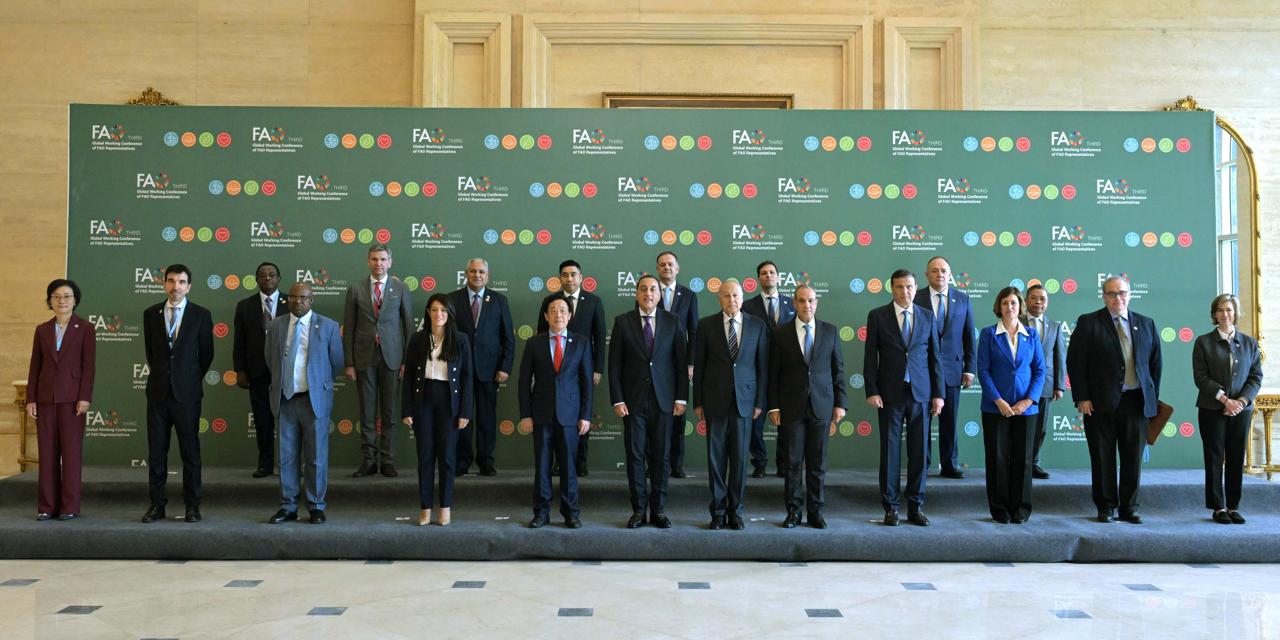
Cairo/Rome - The Food and Agriculture Organization of the United Nations (FAO) opened the Third Global Working Conference (GWC) of FAO Representatives today in Cairo, with the participation of the Prime Minister of Egypt, H.E. Mostafa Madbouly; the Secretary-General of the League of Arab States, H.E. Ahmed Aboul Ghati and FAO Director-General QU Dongyu. Senior FAO leadership, regional representatives, and FAO Representatives from around the world also took part in the opening session.
Hosted by the Government of Egypt from 8 to 10 December, the 3rd GWC provides a platform for direct dialogue between the Director-General, Core Leaders, Senior Management, and FAO Representatives to strengthen global coordination and reinforce FAO’s strategic and operational alignment at all levels of the Organization.
In his address, the Egyptian Prime Minister affirmed that Egypt’s hosting of the Conference reflects the state's unwavering commitment to supporting FAO and its pivotal role in enhancing global food security, advancing agricultural and food systems, and assisting the most vulnerable countries in facing humanitarian and economic challenges.
H.E. Madbouly emphasized Egypt’s strong belief in its regional role as a key contributor to Arab and African food security. This commitment is demonstrated through the transfer of expertise and advanced technologies to sister countries, the implementation of specialized capacity-building programmes for agricultural personnel, active participation in shaping FAO’s regional priorities, hosting regional and technical meetings, and providing direct support to countries most in need in the areas of agricultural production and resource management.
He further stressed that regional integration remains the most effective pathway to addressing the escalating challenges confronting food systems, particularly in the context of climate change, economic crises, and global disruptions in supply chains.
In his opening remarks, FAO Director-General QU Dongyu called on participants to adopt a proactive, agile, and forward-looking approach to ensure that FAO’s strategies and programmes remain responsive to the rapidly evolving global landscape.
He underlined that FAO is operating in an unprecedented environment marked by food insecurity, conflict, climate shocks, and economic instability—conditions that require innovation, modernized systems, and stronger partnerships across all levels of the Organization.
The Director-General highlighted the need to shift from crisis response to resilience building, noting FAO’s global leadership in anticipatory action and disaster risk reduction. Between 2023 and 2024, FAO reached an estimated 2 million people annually through anticipatory interventions and supported governments in strengthening policies and legislation to better prepare for future shocks.
The conference will also address FAO’s strategic positioning and efforts to accelerate the transformation of agrifood systems, focusing on innovation, improved financing mechanisms, and enhanced operational efficiency. Key initiatives under discussion include the Efficiency Roadmap, the Supply Chain Action Plan, and improvements to procurement and technical delivery through expanded use of digital and AI-driven tools.
During the opening session, FAO launched the Villages Recognition Initiative, which celebrates rural communities for their vital contributions to sustainable agrifood systems, biodiversity conservation, food heritage, and inclusive rural development. The initiative, part of FAO’s 80th Anniversary celebrations, is implemented under the FAO Food and Agriculture Museum and Network (MuNe).
In his welcoming remarks, Abdulhakim Elwaer, FAO Assistant Director-General and Regional Representative for the Near East and North Africa, praised the strong partnership between FAO and Egypt across a wide range of flagship programmes, including climate-smart agriculture, farmer field schools, animal health strengthening, value-chain development, water and land management, and digital transformation.
The 3rd GWC builds on the success of the first two Conferences held in Rome (2023) and Bangkok (2024). It aims to reinforce the One FAO approach and ensure the Organization’s global network remains aligned and effective in supporting Members to accelerate agrifood systems transformation and advance progress toward the Sustainable Development Goals (SDGs).