


GBEP Webinar Highlights Belem 4x Pledge to Accelerate Sustainable Fuels
09/12/2025
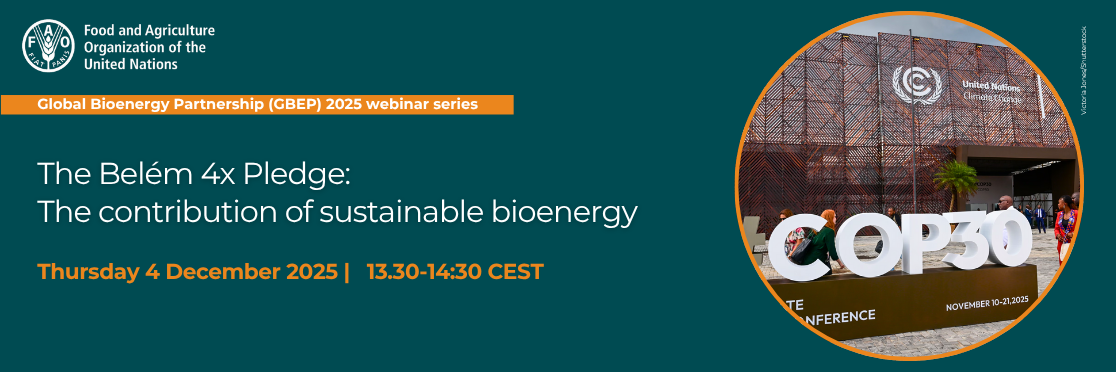
The Global Bioenergy Partnership (GBEP) hosted a webinar titled “The Belem 4x Pledge – The Contribution of Sustainable Bioenergy”, marking the conclusion of its 2025 webinar series.
The event, featuring interventions from Brazil’s Ministry of Foreign Affairs and the International Energy Agency, provided both the political and technical context for the pledge, spotlighting an ambitious international commitment to quadruple the production and use of sustainable fuels by 2030.The pledge, launched at COP30 and co-sponsored by Brazil, Italy, Japan, and India, has already garnered support from 27 countries across diverse regions and economic profiles. The initiative aims to send a strong political signal backed by scientific evidence, promoting technological neutrality and an inclusive approach to fast track the global clean energy transitions.
Michela Morese, FAO Energy Team Leader, opened the session by emphasizing the pledge’s role in aligning energy strategies with sustainability goals. “This initiative is not just about numbers; it’s about creating a fair and just transition that considers environmental, social, and economic dimensions,” she noted.
Otavio Foratini-Lemos Igreja, from Brazil’s Ministry of Foreign Affairs, underscored the importance of sustainable fuels in complementing electrification, particularly for hard-to-abate sectors such as aviation, shipping, and heavy industry. He highlighted the pledge’s focus on international cooperation, harmonized carbon accounting, and capacity building for developing nations. “No country can achieve this alone. Collaboration is key to ensuring equitable benefits and energy security,” he said.
From a technical perspective, Ilkka Hannula of the International Energy Agency (IEA) presented findings from the report “Delivering Sustainable Fuels: Pathways to 2035”. The analysis confirms that a fourfold increase in sustainable fuels is ambitious but achievable within a decade if announced policies are fully implemented. Mr. Hannula stressed that sustainable fuels offer benefits beyond emissions reduction: “They can advance land, water, and waste management, and drive economic development, creating new opportunities, especially in emerging economies”.
Biofuels, biogases, and hydrogen-based fuels play a critical role alongside electrification in the IEA scenario, with a two-fold increase foreseen for biofuels and a three-fold increase in biogases. For hydrogen-based fuels, where production is currently at very low levels, a 70-fold increase is forecasted. However, these projections are global, and increases will differ by region and country.
The discussion explored policy instruments, financing mechanisms, and sustainability safeguards, with panelists agreeing on the need for consistent long-term policies, innovation, and comparable standards. In terms of specific policy instruments, Mr. Hannula highlighted that successful policies have typically been those that incentivize not only volume increases but also reductions in greenhouse gas intensity. He presented a proposed a tiered labeling system for greenhouse gas intensity to improve policy comparability and incentivize continuous improvement.
As the webinar concluded, moderator Constance Miller (GBEP Secretariat) noted how speakers “highlighted the importance of collaboration, innovation, and strong sustainability frameworks as being extremely important.” Although there was agreement on the importance of ensuring sustainability, questions remain on how to integrate sustainability considerations into projections, policies and practice. This will be essential not only to uphold environmental safeguards but also to guarantee social justice and equity throughout the transition. Given its 20-year expertise in bioenergy sustainability, these topics will be captured by GBEP's capacity-building activities in 2026 to support implementation of the pledge.
You can find the recording of the webinar on the FAO YouTube.
The event, featuring interventions from Brazil’s Ministry of Foreign Affairs and the International Energy Agency, provided both the political and technical context for the pledge, spotlighting an ambitious international commitment to quadruple the production and use of sustainable fuels by 2030.The pledge, launched at COP30 and co-sponsored by Brazil, Italy, Japan, and India, has already garnered support from 27 countries across diverse regions and economic profiles. The initiative aims to send a strong political signal backed by scientific evidence, promoting technological neutrality and an inclusive approach to fast track the global clean energy transitions.
Michela Morese, FAO Energy Team Leader, opened the session by emphasizing the pledge’s role in aligning energy strategies with sustainability goals. “This initiative is not just about numbers; it’s about creating a fair and just transition that considers environmental, social, and economic dimensions,” she noted.
Otavio Foratini-Lemos Igreja, from Brazil’s Ministry of Foreign Affairs, underscored the importance of sustainable fuels in complementing electrification, particularly for hard-to-abate sectors such as aviation, shipping, and heavy industry. He highlighted the pledge’s focus on international cooperation, harmonized carbon accounting, and capacity building for developing nations. “No country can achieve this alone. Collaboration is key to ensuring equitable benefits and energy security,” he said.
From a technical perspective, Ilkka Hannula of the International Energy Agency (IEA) presented findings from the report “Delivering Sustainable Fuels: Pathways to 2035”. The analysis confirms that a fourfold increase in sustainable fuels is ambitious but achievable within a decade if announced policies are fully implemented. Mr. Hannula stressed that sustainable fuels offer benefits beyond emissions reduction: “They can advance land, water, and waste management, and drive economic development, creating new opportunities, especially in emerging economies”.
Biofuels, biogases, and hydrogen-based fuels play a critical role alongside electrification in the IEA scenario, with a two-fold increase foreseen for biofuels and a three-fold increase in biogases. For hydrogen-based fuels, where production is currently at very low levels, a 70-fold increase is forecasted. However, these projections are global, and increases will differ by region and country.
The discussion explored policy instruments, financing mechanisms, and sustainability safeguards, with panelists agreeing on the need for consistent long-term policies, innovation, and comparable standards. In terms of specific policy instruments, Mr. Hannula highlighted that successful policies have typically been those that incentivize not only volume increases but also reductions in greenhouse gas intensity. He presented a proposed a tiered labeling system for greenhouse gas intensity to improve policy comparability and incentivize continuous improvement.
As the webinar concluded, moderator Constance Miller (GBEP Secretariat) noted how speakers “highlighted the importance of collaboration, innovation, and strong sustainability frameworks as being extremely important.” Although there was agreement on the importance of ensuring sustainability, questions remain on how to integrate sustainability considerations into projections, policies and practice. This will be essential not only to uphold environmental safeguards but also to guarantee social justice and equity throughout the transition. Given its 20-year expertise in bioenergy sustainability, these topics will be captured by GBEP's capacity-building activities in 2026 to support implementation of the pledge.
You can find the recording of the webinar on the FAO YouTube.