


A global commitment to bioenergy
Bioenergy, a renewable energy source produced from biomass, can significantly contribute to energy access and security, climate change mitigation, food security, and ultimately sustainable development.
Since 2006, the Global Bioenergy Partnership (GBEP) brings together public, private and civil society stakeholders to promote sustainable and efficient use of bioenergy and biomass, particularly in developing countries.
FAO is one of GBEP’s founding partners and has hosted the GBEP Secretariat since its inception, supporting the Partnership’s efforts to advance sustainable bioenergy as part of the global climate and sustainable development agenda.
At present, 23 countries and 16 international organizations are GBEP partners, and 35 countries and 18 international organizations and institutions are participating as observers.
GBEP partners and observers
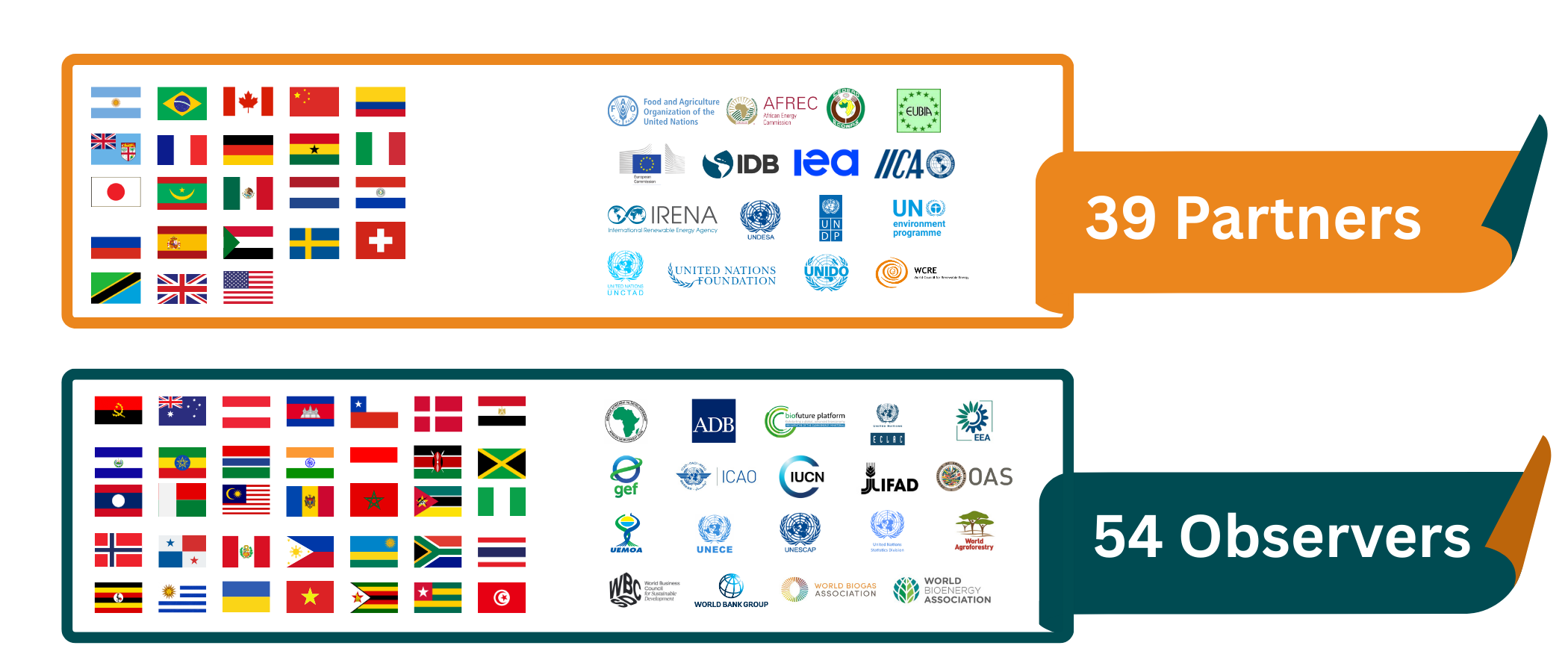 All GBEP partners and observers
Thematic areas

Resources
GBEP webinar - The Belém 4x Pledge: the contribution of sustainable bioenergy
08/12/2025
This webinar aims to enhance understanding of the Belém Commitment for Sustainable Fuels (also known as the Belém 4x Pledge), a multilateral initiative...
“Bioenergy is more than energy” - Prof. Mirjam Roeder at the 12th GBEP Bioenergy Week
15/10/2025
During the 12th GBEP Bioenergy Week, Professor Mirjam Roeder (Aston University), stressed the interdisciplinary nature of sustainable bioenergy.
Highlights
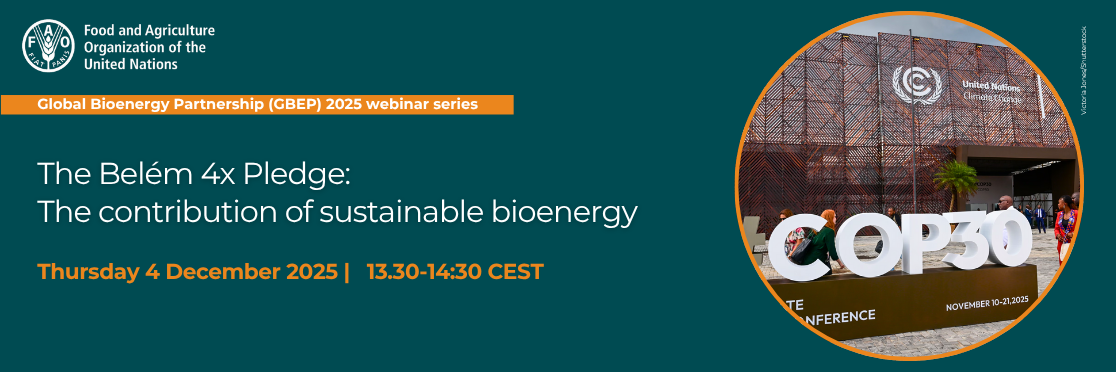
Virtual Event
The Belém 4x Pledge: the contribution of sustainable bioenergy
04/12/2025
The webinar aims to enhance understanding of the Belém Commitment for Sustainable Fuels (also known as the Belém 4x Pledge), a multilateral initiative...
Technical paper
Bioethanol for clean cooking - An analysis of its role in energy transition in Africa
2025
This study provides insights on the potential of bioethanol for clean cooking in various African countries, highlighting key enabling factors and barriers,...
Publications
Global Bioenergy Partnership Sustainability Indicators for Bioenergy: Implementation Guide
01/01/2020
The Implementation Guide for the Global Bioenergy Partnership Sustainability Indicators for Bioenergy has been developed to complement and enhance the first edition of The Global Bioenergy Partnership Sustainability Indicators for Bioenergy, published in 2011. It includes guidance that is based on the implementation of the Global Bioenergy Partnership (GBEP) Sustainability Indicators in fourteen countries, spanning four continents.
Rapid Implementation Framework for the GBEP Sustainability Indicators for Bioenergy: Handbook
12/12/2021
The Rapid Implementation Framework (RIF) complements the Implementation Guide, by supporting and expediting the operationalization of selected working packages. The RIF allows users to conduct an evidence-based prioritization of the GBEP indicators. This means that within six months, it should be possible to carry out a rapid measurement of the critical GBEP indicators and obtain a preliminary indication of likely impacts on sustainability from the most relevant bioenergy pathways in the region.
The Global Bioenergy Partnership Common Methodological Framework for GHG Lifecycle Analysis of Bioenergy - Version ONE
01/10/2010
The 10-step greenhouse gas (GHG) inventory framework is intended to guide policy makers and institutions when calculating GHG emissions from bioenergy and to enable life cycle assessments (LCA) of the GHG emissions of bioenergy to be compared on an equal basis.
Related links
Contact
GBEP Secretariat
Office of Climate Change, Biodiversity and Environment
Viale delle Terme di Caracalla
00153 Rome, Italy