


Strengthening Partnerships for a Low-Carbon Future: Highlights from GBEP’s 2025 Annual Governance Meetings
07/11/2025
The Global Bioenergy Partnership (GBEP) held its 2025 Annual Governance Meetings at the Headquarters of the Food and Agriculture Organization of the United Nations (FAO). The three-day event brought together delegations from country governments, international organizations, and global experts who convened to acknowledge the work completed in 2025 and to jointly define the programme of work for 2026.
Participants included representatives from Argentina, Brazil, Egypt, Italy, Spain, the Philippines, and Uganda, as well as the Clean Energy Ministerial (CEM) Biofuture Platform Initiative, the Economic Community of West African States (ECOWAS) Centre for Renewable Energy and Energy Efficiency (ECREEE), the Economic Commission for Latin America and the Caribbean (ECLAC), the International Energy Agency (IEA), IEA Bioenergy, the International Union for Conservation of Nature (IUCN), the Organization of American States (OAS), the United Nations Development Programme (UNDP), the United Nations Environment Programme (UNEP), the United Nations Statistics Division (UNSD), the World Bioenergy Association (WBA), the Italian Council for Agricultural Research and Economics (CREA), Aston University and Imperial College London from the United Kingdom.
The dialogues contributed to identifying opportunities to further strengthen GBEP’s role in advancing the global development of a sustainable bioenergy sector. They addressed emerging challenges such as emphasizing bioenergy’s key contribution to the broader bioeconomy; showcasing the potential of diverse bioenergy options, along with related policies, strategies, and innovative technologies to support low-carbon, just, and inclusive energy transitions, improving universal energy access; and ensuring the sustainable management of natural resources.
Participants shared knowledge and lessons learned, explored additional opportunities for international collaboration, and discussed practical guidance and methodologies to be further refined through the collaborative efforts of GBEP Partners and Observers, particularly within the Task Force on Sustainability (TFS) and the Working Groups on Capacity Building for Sustainable Bioenergy (WGCB).
Among thematic priorities shaping the Partnership agenda over the coming 12 months, particular attention will be given to the development of guidance and updated methodologies to carry out the sustainability assessment of bioenergy and bioeconomy integrated value chains, and to provide information on data and definitions for woody biomass for energy through a dedicated FAO Info Brief, to be developed in collaboration with FAO, UNSD, IEA and the International Renewable Energy Agency (IRENA). Further actions will be taken to foster a clean cooking transition in developing countries, raise awareness of best practices related to bioenergy policy and practices, and build capacities to advance the adoption of bio-based energy solutions. To support the sustainable implementation of the Belém 4x Pledge, dedicated stakeholder dialogues will be organized through webinars, and a full day focused on sustainable liquid biofuels will be scheduled during the 13th GBEP Bioenergy Week, to be held in the Americas in the second quarter of 2026.
GBEP's commitment to youth has been renewed and, with it, the willingness to replicate the annual GBEP Youth Award and the GBEP Bioenergy Youth Day in the context of the 13th GBEP Bioenergy Week. GBEP activities will systematically integrate considerations of equity and inclusion, with particular attention to gender, vulnerable groups, and marginalized communities.
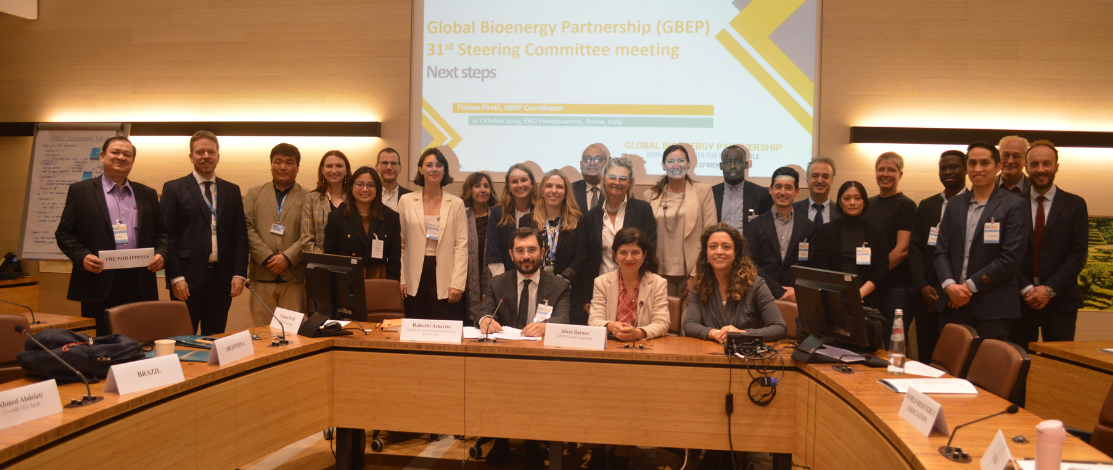
The Meetings concluded with the 31st Meeting of the GBEP Steering Committee, which was opened by Mr. Godfrey Magwenzi, FAO Deputy Director-General and Director of Cabinet, along with the GBEP Co-Chairs, Ms. Alicia Barone, Deputy Permanent Representative of Argentina, and Mr. Roberto Amerise, Director of Cooperation at the Directorate-General for European, International, and Sustainable Finance Affairs (AEIF) at the Ministry for the Environment and Energy Security of Italy (MASE).
In his welcome speech, DDG Magwenzi highlighted the role of GBEP as a unique and inclusive platform for international cooperation on sustainable bioenergy, now approaching its 20th anniversary. He emphasized that “with the support and guidance of GBEP members, FAO has helped countries to perform sustainability assessments of bioenergy and build national capacity to adopt sustainable and modern bioenergy solutions, such as clean cooking. Under FAO’s Energy-Smart Agrifood Systems Programme, we are working with countries to identify and implement sustainable bioenergy solutions that bring benefits across the board.”
The Steering Committee welcomed IUCN as a new Observer of the Partnership, which now has 93 members, including country governments and international organizations. The meeting offered strategic guidance to the GBEP Secretariat, explored ways to further strengthen linkages with international fora, and endorsed the 2026 Programme of Work. The need of a special GBEP Steering Committee meeting was agreed – to be held in the second quarter of 2026 – to discuss opportunities for funding replenishment for the biennium 2027-2028.
The GBEP 2025 Annual Governance Meetings reaffirmed GBEP’s pivotal role as a global hub for collaboration and innovation. They highlighted how, through collaborative efforts and a shared vision, the Partnership provides practical guidance to the international bioenergy community, driving the sustainable development of bioenergy and contributing to the transformation of agrifood systems and related sectors toward a low-carbon, more sustainable future that leaves no one behind.
Participants included representatives from Argentina, Brazil, Egypt, Italy, Spain, the Philippines, and Uganda, as well as the Clean Energy Ministerial (CEM) Biofuture Platform Initiative, the Economic Community of West African States (ECOWAS) Centre for Renewable Energy and Energy Efficiency (ECREEE), the Economic Commission for Latin America and the Caribbean (ECLAC), the International Energy Agency (IEA), IEA Bioenergy, the International Union for Conservation of Nature (IUCN), the Organization of American States (OAS), the United Nations Development Programme (UNDP), the United Nations Environment Programme (UNEP), the United Nations Statistics Division (UNSD), the World Bioenergy Association (WBA), the Italian Council for Agricultural Research and Economics (CREA), Aston University and Imperial College London from the United Kingdom.
The dialogues contributed to identifying opportunities to further strengthen GBEP’s role in advancing the global development of a sustainable bioenergy sector. They addressed emerging challenges such as emphasizing bioenergy’s key contribution to the broader bioeconomy; showcasing the potential of diverse bioenergy options, along with related policies, strategies, and innovative technologies to support low-carbon, just, and inclusive energy transitions, improving universal energy access; and ensuring the sustainable management of natural resources.
Participants shared knowledge and lessons learned, explored additional opportunities for international collaboration, and discussed practical guidance and methodologies to be further refined through the collaborative efforts of GBEP Partners and Observers, particularly within the Task Force on Sustainability (TFS) and the Working Groups on Capacity Building for Sustainable Bioenergy (WGCB).
Among thematic priorities shaping the Partnership agenda over the coming 12 months, particular attention will be given to the development of guidance and updated methodologies to carry out the sustainability assessment of bioenergy and bioeconomy integrated value chains, and to provide information on data and definitions for woody biomass for energy through a dedicated FAO Info Brief, to be developed in collaboration with FAO, UNSD, IEA and the International Renewable Energy Agency (IRENA). Further actions will be taken to foster a clean cooking transition in developing countries, raise awareness of best practices related to bioenergy policy and practices, and build capacities to advance the adoption of bio-based energy solutions. To support the sustainable implementation of the Belém 4x Pledge, dedicated stakeholder dialogues will be organized through webinars, and a full day focused on sustainable liquid biofuels will be scheduled during the 13th GBEP Bioenergy Week, to be held in the Americas in the second quarter of 2026.
GBEP's commitment to youth has been renewed and, with it, the willingness to replicate the annual GBEP Youth Award and the GBEP Bioenergy Youth Day in the context of the 13th GBEP Bioenergy Week. GBEP activities will systematically integrate considerations of equity and inclusion, with particular attention to gender, vulnerable groups, and marginalized communities.
The Meetings concluded with the 31st Meeting of the GBEP Steering Committee, which was opened by Mr. Godfrey Magwenzi, FAO Deputy Director-General and Director of Cabinet, along with the GBEP Co-Chairs, Ms. Alicia Barone, Deputy Permanent Representative of Argentina, and Mr. Roberto Amerise, Director of Cooperation at the Directorate-General for European, International, and Sustainable Finance Affairs (AEIF) at the Ministry for the Environment and Energy Security of Italy (MASE).
In his welcome speech, DDG Magwenzi highlighted the role of GBEP as a unique and inclusive platform for international cooperation on sustainable bioenergy, now approaching its 20th anniversary. He emphasized that “with the support and guidance of GBEP members, FAO has helped countries to perform sustainability assessments of bioenergy and build national capacity to adopt sustainable and modern bioenergy solutions, such as clean cooking. Under FAO’s Energy-Smart Agrifood Systems Programme, we are working with countries to identify and implement sustainable bioenergy solutions that bring benefits across the board.”
The Steering Committee welcomed IUCN as a new Observer of the Partnership, which now has 93 members, including country governments and international organizations. The meeting offered strategic guidance to the GBEP Secretariat, explored ways to further strengthen linkages with international fora, and endorsed the 2026 Programme of Work. The need of a special GBEP Steering Committee meeting was agreed – to be held in the second quarter of 2026 – to discuss opportunities for funding replenishment for the biennium 2027-2028.
The GBEP 2025 Annual Governance Meetings reaffirmed GBEP’s pivotal role as a global hub for collaboration and innovation. They highlighted how, through collaborative efforts and a shared vision, the Partnership provides practical guidance to the international bioenergy community, driving the sustainable development of bioenergy and contributing to the transformation of agrifood systems and related sectors toward a low-carbon, more sustainable future that leaves no one behind.