


Publications on natural resources management, biodiversity and climate change
Adoption of climate technologies in the agrifood system: investment opportunities in the Kyrgyz Republic
01/01/2022
Agrifood systems are major contributors to greenhouse gas emissions and increasingly under pressure to become more resource-efficient. The sector also faces threats from climate change, due to its dependence on natural resources.
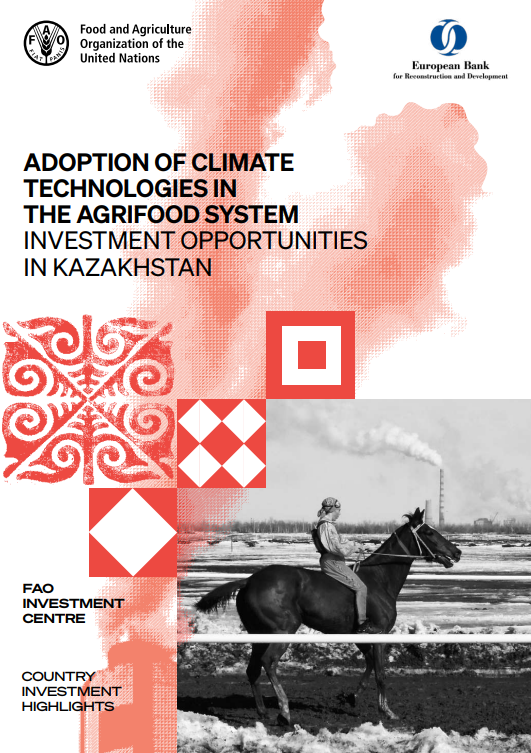
Adoption of climate technologies in the agrifood system: investment opportunities in Kazakhstan
01/01/2022
Agrifood systems are major contributors to greenhouse gas emissions and increasingly under pressure to become more resource-efficient. The sector also faces threats from climate change, due to its dependence on natural resources.
Biodiversity in Action
01/01/2023
Both climate change and biodiversity loss have distorting social and economic impacts on development and cause severe risks for food security, nutrition and livelihoods among rural populations in Europe and Central Asia, most of whom depend directly or indirectly on the agricultural sector.
Policy analysis of nationally determined contributions (NDC) in Europe and Central Asia
15/06/2018
This publication compiles and analyzes the most relevant and updated information on policies and regulatory frameworks related to climate change in the region, including information on access to available climate finance to support countries in the implementation of their goals under the Paris Agreement.
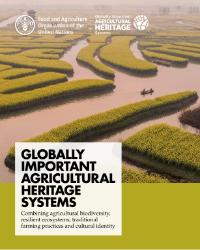
Globally Important Agricultural Heritage Systems (GIAHS). Combining agricultural biodiversity, resilient ecosystems, traditional farming practices and cultural identity
30/04/2018
For centuries, farmers, herders, fishers and foresters have developed diverse and locally adapted agricultural systems managed with time tested, ingenious techniques. These practices have resulted in a vital combination of social, cultural, ecological and economic services to humankind. “Globally Important Agricultural Heritage Systems” (GIAHS) are outstanding landscapes of aesthetic beauty that combine agricultural biodiversity, resilient ecosystems and a valuable cultural heritage.
Reducing Disaster Risks and Strengthening Resilience of Farmers to Natural Hazards in The Western Balkans - TCP/RER/3504
10/06/2019
The Western Balkans region is prone to natural hazards, such as floods, landslides, droughts and forest fires, as a result of its geological structure, and climatic and topographic characteristics. The agriculture sector is negatively impacted by these hazards, with damage caused to agricultural infrastructure and equipment and losses in crops, livestock, forestry and fisheries.
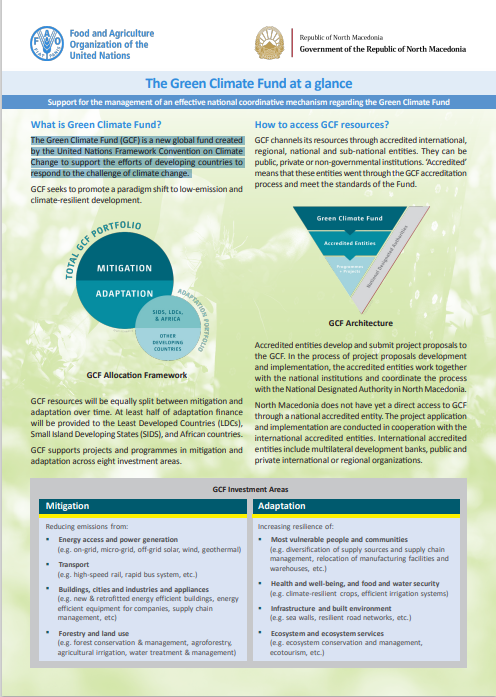
The Green Climate Fund at a glance
15/05/2019
The Green Climate Fund (GCF) is a new global fund created by the United Nations Framework Convention on Climate Change to support the efforts of developing countries to respond to the challenge of climate change.
Gender, Environmental and Social Policy of the Green Climate Fund
15/05/2019
This factsheet is jointly developed by the Cabinet of the Deputy President of the Government of the Republic of North Macedonia in charge of Economic Affairs, in its role as National Designated Authority (NDA) to GCF and FAO in the frames of the project “Support for the management of an effective national coordinative mechanism regarding the Green Climate Fund.
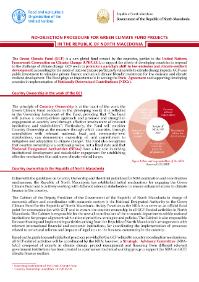
No-Objection Procedure for Green Climate Fund Projects in the Republic of North Macedonia - Factsheet
15/05/2019
The Green Climate Fund (GCF) is a new global fund created by the countries, parties to the United Nations Framework Convention on Climate Change (UNFCCC), to support the efforts of developing countries to respond to the challenge of climate change. GCF seeks to promote a paradigm shift to low-emission and climate-resilient development, accounting for the needs of nations that are particularly vulnerable to climate change impacts.
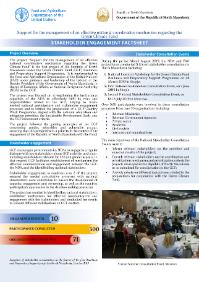
Stakeholder Engagement Factsheet - Support for the management of an effective national coordinative mechanism regarding the Green Climate Fund
15/05/2019
The aim of this factsheet is to present the stakeholder engagement activities implemented in the frames of the North Macedonia’s first Green Climate Fund Readiness and Preparatory Support Project “Support for the management of an effective national coordinative mechanism regarding the Green Climate Fund”
Manual for the Operations of the National Designated Authority for Engagement with the Green Climate Fund
15/05/2019
This Manual aims to provide guidance to the National Designated Authority on the engagement with the Green Climate Fund, on its operations and roles to facilitate the implementation of climate change activities in North Macedonia.
Green Climate Fund handbook for North Macedonia
15/05/2019
The Green Climate Fund Handbook for North Macedonia was prepared by the FAO Regional Office for Europe and Central Asia, under the leadership and guidance of the Cabinet of the Deputy President of the Government of the Republic of North Macedonia in charge of Economic Affairs as National Designated Authority to the Green Climate Fund (GCF).
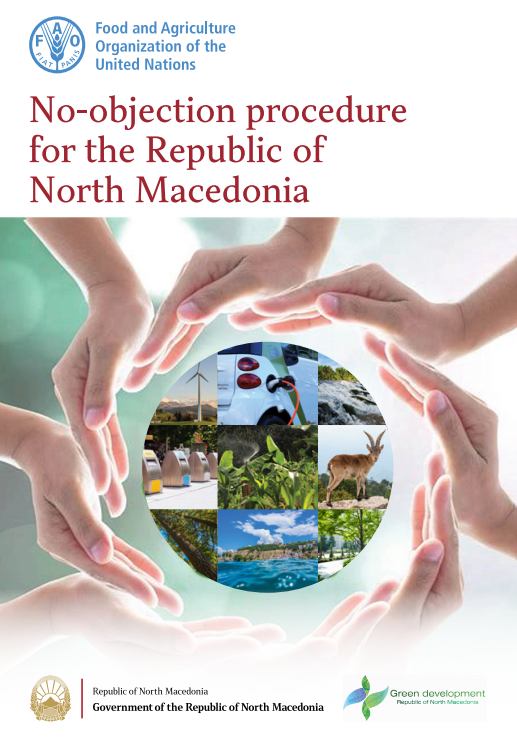
No-objection Procedure for the Republic of North Macedonia
01/05/2019
This technical document is one means by which country ownership is strengthened for enhanced access to climate finance and for transparent and participatory technical assessment of country priorities in its engagement with the GCF.
Recommendations for the establishment, regeneration, reconstruction, and maintenance of the shelterbelts in the Steppe and Forest-Steppe zones (in Ukrainian)
01/05/2019
The recommendations include tips for design and principles of construction of shelterbelts on irrigated, non-irrigated, and saline lands of forest-steppe and steppe zones in Ukraine, and describe the principles of maintenance of shelterbelts, as well as providing a list of species of trees and shrubs for planting.
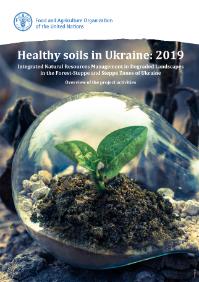
Healthy soils in Ukraine: 2019
20/05/2020
The brochure provides information on events, activities and achievements of the GEF-funded FAO project "Integrated Natural Resources Management in Degraded Landscapes in the Forest-Steppe and Steppe Zones of Ukraine" in 2019.
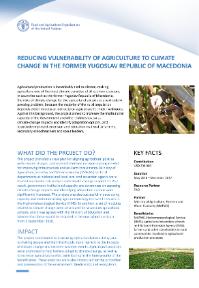
Reducing Vulnerability of Agriculture to Climate Change in the Former Yugoslav Republic of Macedonia - TCP/MCD/3503
01/05/2019
Agricultural production is inextricably tied to climate, making agriculture one of the most climate-sensitive of all economic sectors. In countries such as the former Yugoslav Republic of Macedonia, the risks of climate change for the agricultural sector are a particularly pressing problem, because the majority of the rural population depends either directly or indirectly on agriculture for their livelihoods.
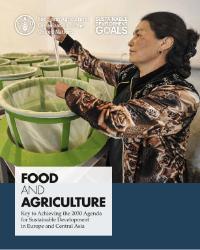
Food and agriculture Key to Achieving the 2030 Agenda for Sustainable Development in Europe and Central Asia
01/05/2019
This publication presents FAO's work in support of the achievement of the SDGs in Europe and Central Asia. Featuring selected country case studies across the region, it describes how FAO and partners are already supporting countries to achieve multiple SDGs targets through current project and programmes.
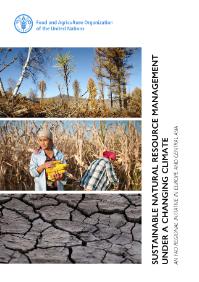
Sustainable Natural Resource Management under a changing climate
01/05/2021
The aim of the brochure to introduce the main objective of this Regional Initiative its strengthen countries’ ability to manage their natural resources sustainably, while also coping with climate change and reducing the risk of disaster in agriculture, forestry and fisheries.
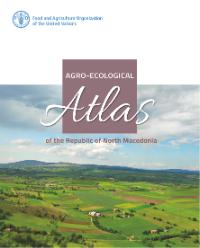
Agro-ecological atlas of the Republic of North Macedonia
01/03/2020
Agriculture has an important role in North Macedonia and in 2017 it accounted for 7.9 percent of the gross domestic product (GDP) in the country. However, agriculture’s share of the country’s GDP has been decreasing for the past decade, and the need to improve agricultural productivity has become an important challenge.
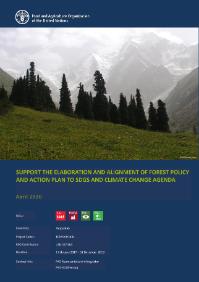
Support the Elaboration and Alignment of Forest Policy and Action Plan to SDGs and Climate Change Agenda - TCP/KYR/3603
01/05/2020
Although Kyrgyzstan is a country with little forest cover, its forests provide a wide range of goods and services and are particularly important for the local communities. More than 35 percent of the population lives below the poverty line.